

The Synopsis of the Opera Zarqa Al-Yamama
Welcome back!
Last time, we looked at the historical evidence behind the story of the opera Zarqa Al-Yamama, scored by Australian composer Lee Bradshaw. Today, we are going to look at how the story became a libretto, and at how the libretto became an opera.
The crafting of a miracle
The initiative for a new, original Saudi opera was spearheaded by the Kingdom of Saudi Arabia’s Ministry of Culture, through the efforts of the Theater and Performing Arts Commission and of the National Theatre.
Having witnessed with my eyes what was being done, and what passion, enthusiasm, and dedication everyone involved put into this, I couldn’t help but be moved. Having the chance to congratulate myself with Mr. Sultan Al Bazie, the CEO of the Theatre and Performing Arts Commission, after the premiere, and hearing how calmly he mentioned they hoped this would mean something for their people, encouraging them to embrace a career in the arts, simply made me capitulate. Coming from a country—Italy—where culture, music, education, and art funds get cut more every year in favour of military expenses, this was a heavy blow.
The libretto
The task of drafting a libretto for the first grand opera in Arabic language, and the first opera of the KSA, was given to Saudi poet and playwright Saleh Zamanan. He won several prizes for his collections of poems and plays, and his works have been translated into numerous languages.
The resulting book, completed in 2021, included a summary of the story, a list of the characters, and the integral text. The final version that we hear in the opera is an adaptation of Mr. Zamanan’s text to best suit the musical context and was a joint venture conducted by the composer himself, Lee Bradshaw, and his assistant Cathryn Burgess.
The reason this adaptation was necessary is simple: the original text is structured more as a theatrical play—like Pirandello, or Čechov, or even Shakespeare—, and it would have been perfect for a staged representation not including music. When an opera libretto is needed, though, many other aspects come into play, the main one being—you guess it—the music!
History tells us how many letters Wolfgang Amadeus Mozart and Lorenzo Da Ponte exchanged while creating Don Giovanni or Le nozze di Figaro, or how many more or less civilised discussions Giuseppe Verdi and Arrigo Boito had over Otello. One thing is certain: ultimately, the composer always had the final say!
Dramatis Personae
We now enter a more delicate section, since not all the characters we encounter in the opera correspond to the historical characters we described in the previous article. In parentheses after their name, the chosen voice register will be listed.
Starting from the title role, Zarqa al-Yamama (mezzo-soprano), her name meaning “the blue-eyed woman”, she symbolises wisdom and insight, and is the embodiment of the Arab knowledge deeply rooted in the desert. Being the seer of the Jadīs tribe, Zarqa has the gift of foresight through the interaction with the “Disappeared Arabs” who come to her in visions with omens about the future. She is the sister of Riyāh b. Murrah of the Ṭasm tribe, though this is not revealed to us at the beginning of the opera1.
Then we have Hazila (soprano — dramatic), “the Mother”, representing love, devotion, and sacrifice. She is the Matriarch of the Jadīs tribe and is in a custody dispute with her estranged husband (Qabis, who appears in the opera as a non-singing character) over her son. She seeks a resolution from King ‘Amlūq of Ṭasm2.
Afira bin Ghifār (soprano — lyric) of the Jadīs tribe, is “the Virgin”, symbolising innocence and virtue. She is engaged to her lover Naoufel and sister to Al Aswad bin Ghifār3.
King Amliq of Ṭasm (bass), symbolises the universal forces of chaos, destruction, and terror. In the opera, the character is merged with the Commander of the Armies of King Taba and labelled “Commendatore” in the score, a clear reference to Mozart’s Don Giovanni. To be coherent with the story, the army that decimated the Jadīs belonged to King Ḥassān bin Tubba’, sovereign of the Himyarite Kingdom. The name “Taba”, possibly a misspelling of Tubba’, may refer to King Ḥassān’s son, Sharhabil Yakkuf, known in Arabian folklore as Tubba’ bin Hassan. He rose to the throne around 470 CE, after his uncle had murdered his father and usurped the throne, so at least 20 years after our events4.
Riyāh b. Murrah (baritone — lyric) is, according to our story, one of the few survivors of the massacre of the Ṭasm at the hands of Jadīs. In the opera, he covers the additional role of Attendant to King Amliq. Brother to the visionary Zarqa, he possesses the ability to travel on the wind, but it is unclear if he is also a visionary himself.
Al Aswad bin Ghifār (tenor) symbolises pride and ego, his character demonstrating how good intentions can become agents of personal corruptibility. He is Afira’s brother and a nobleman of the Jadīs tribe. The fact that he would then become king of the tribe after the “coup” is not covered in the opera.
Two more characters appear, Naoufel (tenor) and Nora. Naoufel is the groom to Afira and is actually the poet, Saleh Zamanan, representing himself in the work. He is the masculine representation of innocence and virtue. Nora, instead, is a contemporary witness that tries to bridge the past and present in the opera. The curiosity in her gaze seeks to unravel the mysteries of the story as it unfolds in front of her. She could be defined as a seeker of timeless human experiences.
If we compare this list with the story described in the previous article, we immediately notice how neither of Hazila, Qabis, and Afira are mentioned by al-Tabari in his book—History of the Prophets and Kings—which was completed by 915 CE. There is another source, though only in Arabic, which mentions these characters. It is the Mu’jam al-Buldan, literally “The Dictionary of Countries” by Yaqut al-Hamawi (1179–1229). His masterpiece, composed between 1224 and 1228—so three centuries after al-Tabari’s work—, is a painstakingly organised alphabetical gazetteer of the known world that includes place name origins, geographical information, and biographies of notable individuals. With more than 12,952 entries and thorough indices, it provides insights into the medieval world by drawing on earlier works as well as his own travels. The text is considered a reliable and authoritative source, and it contains valuable geographical and historical information about the Yamamah land5. Only a single section concerning Persia has been translated into French6, while none of it appears to be available in English.
In this book, there is a section on the Yamamah region (then called Jaww or Jūwā), where it is mentioned how its name was derived from Yamamah, the daughter of Saham ibn Tasim. The whole story including the aforementioned characters is included in the book, and can be read (in Arabic) starting from page 442 at this link. As with all stories of the past, we can do little more than trust the sources we have, and derive our best conclusions.
According to the author of the libretto, the opera’s characters have been shaped by mixing historical records and mythical recounts implemented by oral tradition.
In the end, it is not relevant what version of the story we choose, rather that we get a more profound understanding of the context the music will have to bring back to life.
Synopsis
It’s now time to go through what we see on the stage, which reflects the choices of Stage Director Daniele Finzi Pasca. The opera is divided into two acts, respectively seven and five scenes long. Each act has one intermezzo, before scenes 3 and 9.
Act 1
Scene 1. Al-Yamamah
The little girl Nora comes first on stage to open the curtain, the pizzicato of the double bass marking the beginning of our journey through time. The virgin Afira is waiting for her future husband, Naoufel, who is away hunting. She suffers his being afar, her tears washing away the henna she used to paint her hands. Zarqa, the blue-eyed visionary of the Jadīs tribe, comes near trying to console her, saying how love shall guide her way. Not content, Afira insists, asking what Zarqa sees beyond the horizon. While she sees her lover coming back, she also sees heartbreak. The scene concludes with the voice of the Disappeared Arabs whispering a gloomy warning.
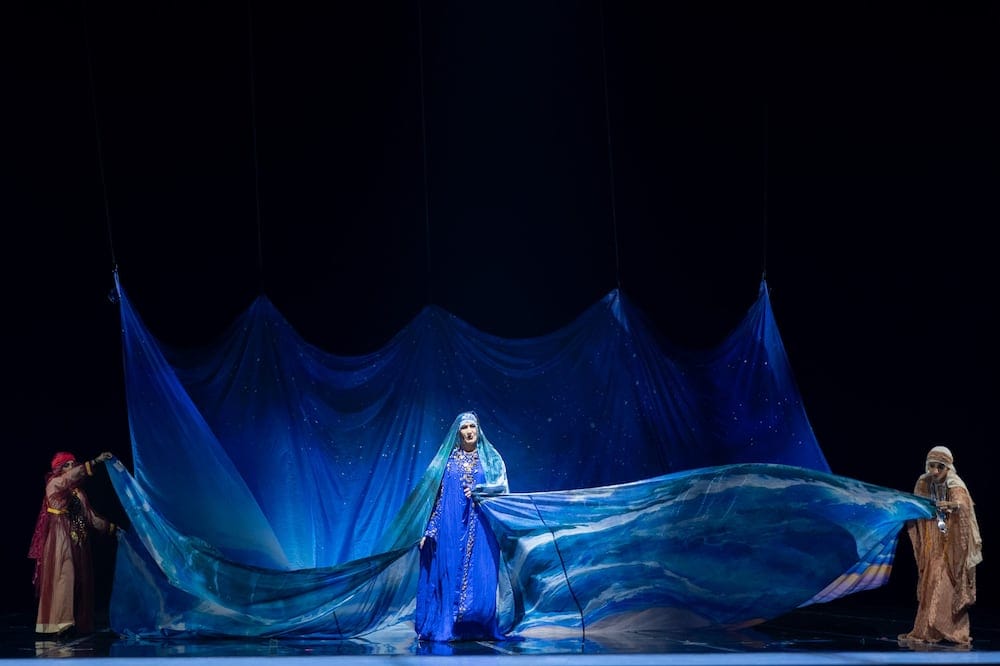
Scene 2. The Throne Room of Amliq.
The focus transitions to the throne room of King Amliq of Ṭasm, with the power of the brass section masterfully painting his tyrannical oppression.

Here Hazila, esteemed matriarch of the Jādis tribe, seeks justice for a custody dispute with her former husband, Qabis, in one of the most poignantly moving melodic moments of the opera. The menacing “theme of tyranny” comes back, with King Amliq enslaving their son in his personal vision of a fair resolution. Hazila protests against the injustice of this decision, though causing more harm than good. Amliq, enraged, resolves that no virgin of Jādis shall marry unless he beds her first.
Intermezzo — Quartet
While these events are unfolding, Afira is daydreaming, accompanied by two bridesmaids, when her groom, Naoufel, arrives. He encourages her not to lose hope, as love will prevail.
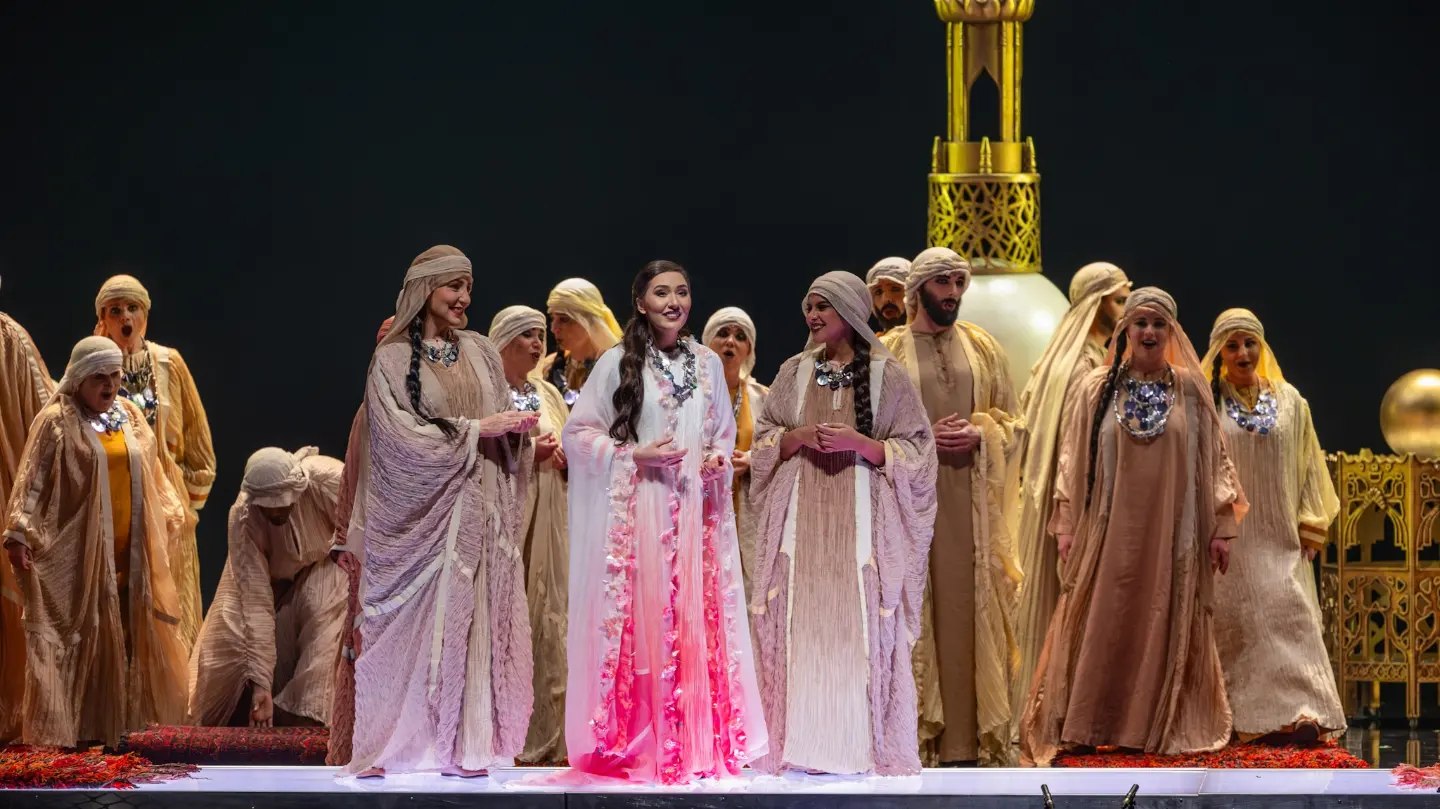
Scene 3. Afira’s wedding. The Night of Tears.
On the day of Afira and Naoufel’s wedding, amidst dances and songs, King Amliq and his soldiers burst into the banquet, bringing terror to the members of the Jadīs tribe and ruining the celebrations. The sovereign takes the bride and refuses to duel with her brother, Al Aswad, warrior of the tribe, who promises to avenge his sister, saying that no humiliation shall pass.
Amliq promises to exterminate the tribe if they do not submit, and the scene closes with a painful lament from Zarqa, supported by the sobbing of the whole Jadīs tribe.
Scene 4. The Tears of Afira.
The next scene shows Afira emerging from Amliq’s bedchamber, wracked with suffering, and asking what she did to be forced against her will. There is a long chorus following Afira’s solo, during which Hazila tries to console her.

Scene 5. The Woe of Hazila.
Hazila feels squashed by the sense of responsibility for what happened to Afira7 and her desperate cry is heard by the champion of the Jadīs tribe, and brother to Afira, Al Aswad bin Ghifār. They then gather the tribe, in front of which “The Black” gives an inspiring speech. The tribe joins the fray, and we can feel their blood boiling, as they ready to strike!

Al Aswad organises a “surprise party” for King Amliq and the Ṭasm tribe, where they shall feast in his honour, swear loyalty, and promise gifts. With the celebration underway, they will strike.
Zarqa tries, in vain, to convince the warrior not to go down this path of vengeance and suffering.
Scene 6. Zarqa’s Lament.
The voice of the Disappeared Arabs can once again be heard in the distance, and Zarqa desperately sings about how her people’s thirst for vengeance will be its undoing. She keeps having visions of “empty homes and so much death”, and Hazila tries to understand what that means. They are interrupted, though, by the bloodthirsty voices of the Jadīs tribe sharpening their swords.
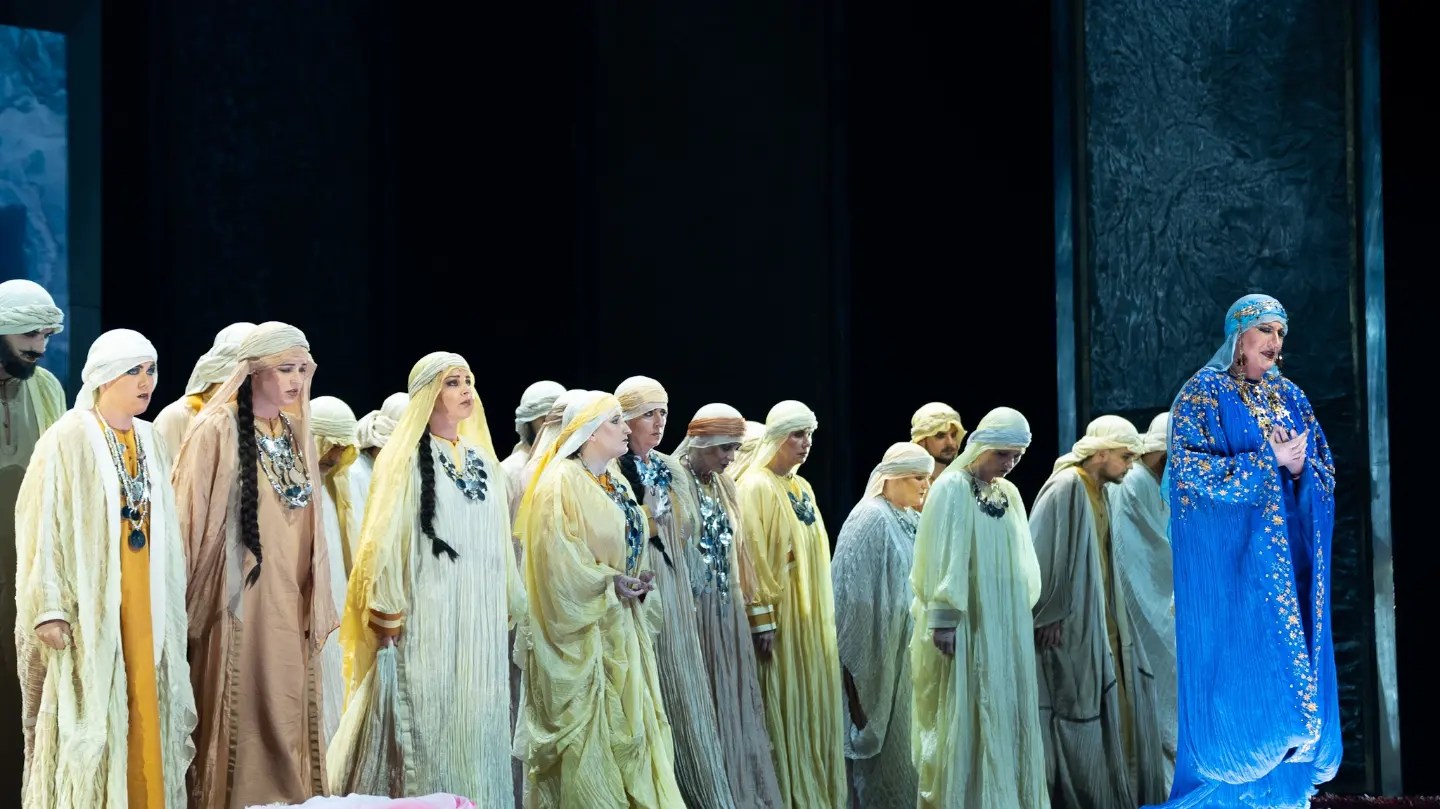
Scene 7. War Dance.
The first part of this scene is occupied by the Jadīs tribe performing a war dance. Hazila is visibly worried and asks Zarqa why all around is looming with fear. The first act closes with Zarqa revealing that there will be no tomorrow, neither for Ṭasm nor for Jadīs.

Act 2
Scene 8. The Death of Amliq
King Amliq reaches the Jadīs encampment, accompanied by the royal fanfare. He notices Hazila and tells her that her son is dead. He then orders more wine, and notices how strong it is8. Al Aswad begins praising Amliq while the orchestra engages in an ostinato accompaniment.
At this point, Amliq asks to see Al Aswad’s sister, Afira. As she enters the room, singing the same melody that opened the opera, she gives the signal, and the massacre of Ṭasm takes place. Riyah’s life is spared as Zarqa’s brother, and he is allowed to flee south.
The tribe burst into celebration, Al Aswad’s pride swelling in each passing moment, emphasising that, in his own way, he is no different from Amliq9. In the distance, the Disappeared Arabs once more sing “Woe to the tribe”, but the Jadīs cannot hear their warning.
Intermezzo — Hijeni
While Nora is accompanied on stage by a Ney flute and an oud, Zarqa weeps tears blue as her eyes, both for those who are no longer alive and for those who remain.
Scene 9. The Desert Storm
Riyah bin Murrah flees south and reaches the army of King Taba10, led by a fierce Commander.

He briefs them on the massacre of Ṭasm by the Jadīs and pleads the commander to bring justice. Riyah warns them of Zarqa’s clairvoyance and suggests that they hide behind uprooted trees during the march.
Scene 10. Zarqa’s Prophecy.
While the Jadīs are still celebrating, Zarqa spots the approaching army and tries to warn her people. Al Aswad and his advisors do not listen to her, believing she has lost her mind.
Hazila and Zarqa try to console each other, eventually accepting to leave them to their faith.
Scene 11. The Death of Hazila.
Broken by the pain of the loss of her son, Hazila silently dies in Zarqa’s arms. The seer sings a delicate farewell song to her friend, who will soon join the Disappeared Arabs.
As we will see in the musical analysis, what follows now is perhaps the most incredibly beautiful moment of the opera, with the choir singing their lullaby to Hazila’s eternal sleep, accompanied by divisi cellos (could you ask for anything more?).
Scene 12. Battle Chorus & Finale.
A short intermezzo played on the ney and oud introduces the terrifying attack of the Himyarite king’s forces. The curtain then lifts to a pile of human bodies following the massacre.

The army’s Commander walks through the dead accompanied by Riyah, while the ghosts of Jadīs sing. Despite Riyah’s pleas, the Commander, threatened by Zarqa’s mystical chant where she says that this moon is the last one he will see, plucks her eyes out11.
Before dying, Zarqa passes her antimony to Afira, stating that she will be the next seer of the Arab people. Afira takes the stibium, applies it to her eyes, and sings the closing aria of the opera. The power of this text can only be conveyed by quoting it directly:
Oh, if only I were daylight’s grace,
to witness Arab folk, a destined race,
scattering love anew upon our souls.
If only I were tomorrow, that distant place.
We may be gone.
A new day is coming, people, a new dawn will arrive.
Arab countries be patient.
I hear weddings coming tomorrow.
We may be gone.
The curtain closes on a rainfall of rose petals blessing Afira’s and, by consequence, the Arab people’s ascension.

Bottom line
That’s it for the second part of this trilogy of articles on the opera Zarqa Al-Yamama. This was a long one, so thank you for surviving to this point.
My heartfelt thanks to Dr. Khalid Amine (Ph.D.), Senior Professor of Performance Studies, AEU, Morocco, for his most valuable help in understanding the sources and for correcting my mistakes.
Next time, we will plunge head-first into the music. I’m sure you will not want to miss it, so stay tuned!
You can join my mailing list here, browse my editions here, and check what’s available for print in the HNE Store.
My YouTube channel contains video renditions of most of my editions.
Until next time, thank you.
Michele
- Possibly to simplify fruition for non-Arab readers, Riyāh’s name has been changed to Riyah Ibn Murra, and the Ṭasm tribe has been rendered as Tassam. To the ear, the Arabic text is faithful to the original. ↩
- In the opera he is called “King Amliq” and it is also pronounced like that, but I have not found definitive sources on his true name. ↩
- In the opera, he is called “Ben Afar Al Aswad”, and addressed as “The Black”, which is the translation of “Al Aswad”. ↩
- For more information, check this article: https://en.wikipedia.org/wiki/Sharhabil_Yakkuf ↩
- Learn more about the author here: https://en.wikipedia.org/wiki/Yaqut_al-Hamawi. A copy of the original work (in Arabic) is available here: https://www.loc.gov/item/2021666167 ↩
- Access it here, on Archive.org: Dictionnaire géographique, historique et littéraire de la Perse et des contrées adjacentes, extrait du “Mo’djem el-Bouldan” de Yaquout, et complété à l’aide de documents arabes et persans pour la plupart inédits ↩
- In al-Hamawi, the hatred of the tribe for what Hazila has triggered is vividly described. ↩
- This is a deviation from the story to avoid violence on stage. The king is poisoned instead of being passed by the sword. ↩
- In Al-Tabari, we learned that he briefly became King Al Aswad of Jadīs after the death of Amlūq. ↩
- Ḥassān bin Tubba’, according to al-Tabari. ↩
- This is symbolised on stage by the Commander tying a red cloth over her eyes. ↩
 Music Preparation Services
3 thoughts on “Staging History”