
announcing the “Pot-Pourri” for cello and guitar, Op. 21
This article is an expanded version of the Editorial Notes that can be found in the published edition, available at this link. A promotional video of this score can be watched here.
EDITORIAL NOTES
For the second episode of Phase 2 of the Dotzauer Project, dedicated to his chamber music works, I chose a rather rare instrumentation: the cello and guitar duo. The general production for this specific duo is incredibly scarce, possibly because of the complex balance between the sonorities of the two instruments. A sensitive cellist, though, can meld his melody with the harmonic support of the guitar, and profit from the richness of its timbre.
The Pot-pourri for Cello and Guitar Op. 21 by Justus Johann Friedrich Dotzauer (1783–1860) is a piece of lyrical, brilliant character, where the cello sings above a sea of guitar chords. It is clear that the cello, like a singer in an operatic aria, is the main actor here; nonetheless, the guitar part is more than a trivial succession of chords, and it is crucial in helping the cellist drive the music line effectively. We can compare this to the same role the basso continuo had just a few decades before, when its realisation was just as important as the solo line.
It has not been possible to determine with absolute certainty the composition date of this piece. The 1817 edition of the Allgemeine Musikalischer Zeitung mentions it, bearing opus number 21, among that year’s new publications, but, a few lines above, we see another piece by Dotzauer, with Op. 41 next to it. The plate number of the only publicly available source is 4203 from Breitkopf & Härtel, which would point to around 1826. It is therefore possible that the edition the AMZ refers to is now lost, or that Op. 41 was only in manuscript form back then. Further research on surrounding creations points to this piece having been written around 1811-2. Without access to private collections which may hold unique copies of this specific piece, we may never know.
The Pot-pourri for Cello and Guitar, Op. 21
What exactly is a Pot-pourri? In non-artistic environments, a potpourri is a mixture of dried, naturally fragrant plant materials used to provide a gentle natural scent, often placed in a decorative bowl. In music, it describes a kind of musical form where the individual sections bear no strong connection or relationship to each other, being simply juxtaposed one next to the other. It is typical of the fantasia form, or of collections of favourite tunes, like arias from a popular opera, and it enjoyed great success throughout the first half of the XIX century. Dotzauer alone wrote no less than ten pot-pourris, and so did his colleagues, both cellists and otherwise.
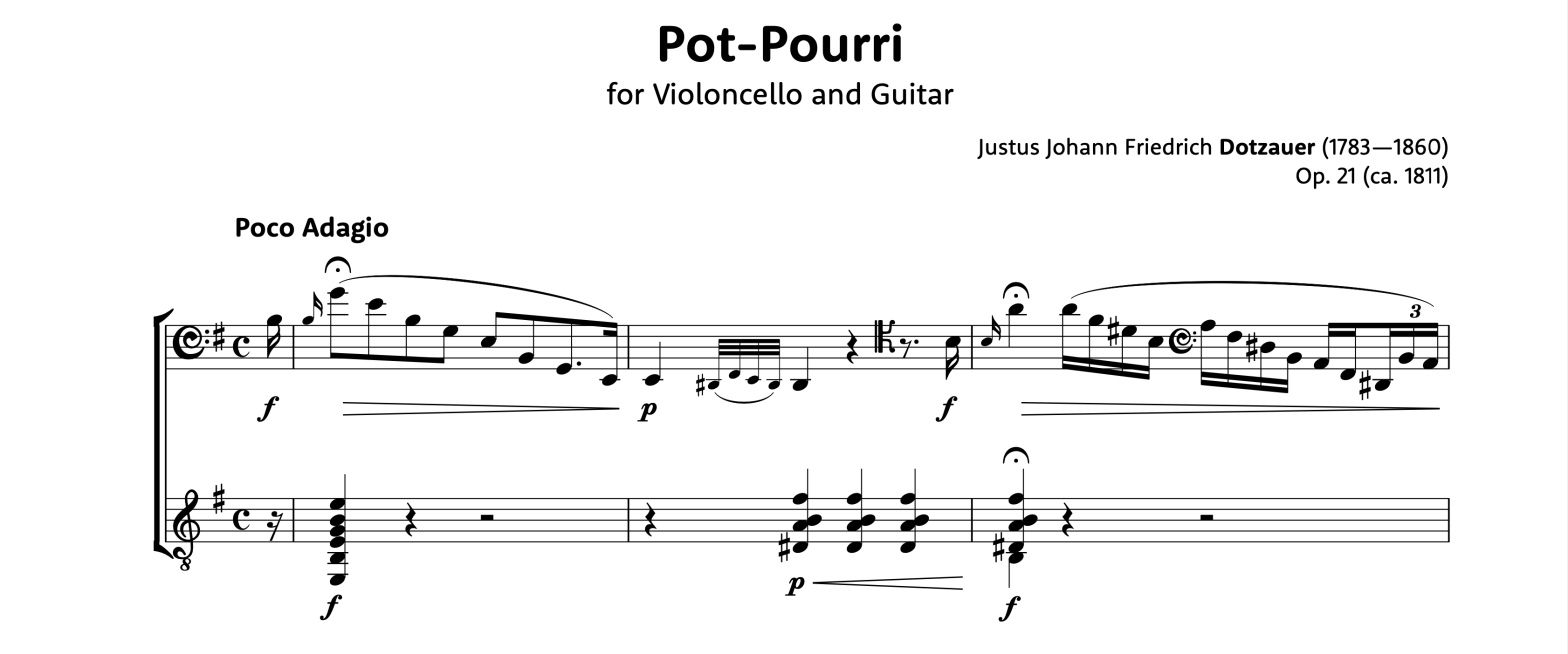
The Pot-Pourri for Cello and Guitar, Op. 21, is divided into four main episodes, all played seamlessly without interruption. The key is E minor, and the piece starts with a cello recitative labelled Poco Adagio. The melody is masking a deeply harmonic writing, with the guitar strumming the same chord played in arpeggios by the cello. When the guitar takes the arpeggios up, the cello then starts singing a declamatory tune. The cello then accompanies the guitar in one of its few melodic moments, with slurred arpeggios in pianissimo. This first episode closes suspended on a dominant seventh chord, ready to introduce the main melody of the piece, marked Andante.
The second episode is in Common time (4/4) with an upbeat of a half bar which, coupled with its repeated structure (AABB), gives it a form reminiscent of a Gavotte of the old times.

The second section (B) alternates solo recitativo lines with the theme returning enough times to sink into the listener’s memory. The next section (C) offers a variation in triplets on the same melody, increasing the virtuosity of the cello line. Developed repeats of sections B and C follow each other in quick alternation, with the second repetition of C evolving from triplets to groups of four notes, yet a notch faster. This episode concludes with a poignant lyrical line, rich in ornaments, accompanied by a dense chordal guitar line, ferrying the listener from E minor to G major.
The third episode is a Larghetto in 3/4, where the cello’s lyrical voice is finally unleashed. The form is simple binary with repeats, the first going to the dominant, and the second coming back to the tonic of G major. A coda follows, with the cello exploring the natural harmonic possibilities of the first positions of the neck, before resuming the singing with a dramatic melody that brings us back to E minor. The second episode (Andante) briefly makes its comeback, offering the first two sections without repeats, and ending in a suspended cadence marked with “morendo” to slow everything down before the explosive finale.
The fourth and final episode, in 2/4 time, is marked Presto, and sounds like a rush against time, with the cello playing a continuous stream of triplets until the end. The guitar keeps up with the cello using strummed chords, and the piece concludes tragically, in the same E minor where it started.
About this edition
This edition is based on the only surviving source from Breitkopf & Härtel, plate number 4203. No autograph has been found so far. Several edits have been necessary, including wrong notes and incoherent dynamics. The source does not contain a score, rather only the two separate parts, whose copying process at the time may have caused the inconsistencies found. Relevant changes are listed below in the Critical Notes section, while smaller one are simply marked in square brackets in the full score.
Dotzauer added a few fingering suggestions to the cello part, which have been kept in the solo part only. The separate parts include performance suggestions for both instruments. The guitar part was curated by Emanuele Buono, 1st Prize winner of the “Michele Pittaluga” Guitar Competition of Alessandria in 2013, while the cello part is offered in two additional versions beside the original one. The first contains the wonderful contribution of Australian cellist Josephine Vains, who shared with us her historical performance suggestions. The second, instead, includes my modern performance ideas.
The Editor
Michele Galvagno
Saluzzo — March 8th, 2024
 Music Preparation Services
2 thoughts on “Dotzauer Project – Episode 11:”