
Phonetic transformations (Part 8)
Welcome back!
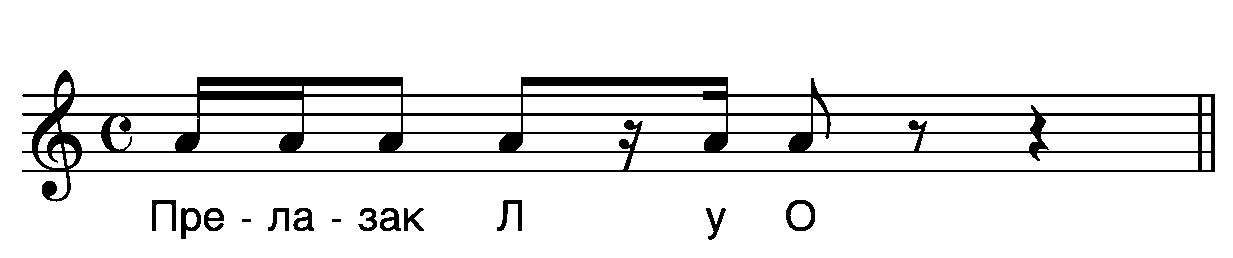
It is incredible how time flies, and it has been five months since my last post on the Serbian language. I spent two of them in Serbia, where it was the most incredibly scorching-hot summer in memory. Spending all day talking Serbian, my brain felt it overkill to also write these lessons. Nevertheless, we are back on track with a new phonetic transformation, that is the trasformation of the L in O. In Serbian, this is called прелазак л у о, literally “L’s transition into O”. For context, прелаз is also the act of crossing something, like crossing the street.

The transformation of the L in O
This transformation occurs when the consonant л is found at the end of a word or syllable. It is found in masculine nouns of the first declination and in some feminine nouns of the fourth declination ending in -о. In practice, the fact that in a dictionary, we would find the nominative singular form of a noun, we are witnessing at the completed transformation already. The л, in fact, appears in all cases before the ending, except for the nominative and accusative singular of masculine inanimate nouns: the word сто (IT: tavolo; EN: table), was originally стол, became стоо and the second о got assimilated, as we will see in the next (and final!) lesson on these transformations.
Nominative singular of substantives
This mostly happens with masculine nouns, or with feminine ones ending in -о. If the -о is preceded by the vowel -а, then it is subjected to the непостојано а rule.
The original посал became посао (IT: lavoro; EN: work/job), while in the other cases the л survived: посла (gen. sing.). Notice how the genitive singular should have been посала, but the first A fell.

Other examples are: угал > угао (IT: angolo; EN: angle), орал > орао (IT: aquila; EN: eagle), сол > со (IT: sale; EN: salt). The genitive singular case for these nouns is, respectively: угла, орла, and соли.
The л usually comes back in adjectives derived from those substantives, such as пословни (IT: d’affari; EN: related to business) which derives from посао. An interesting exception is стони (IT: da tavolo; EN: tabletop), derived from сто, where in Serbian the л has not come back while in Croatian it has: столни.
Nominative singular of masculine adjectives
The word бео (IT: bianco; EN: white) was originally бел, and the л survives in the feminine and neutral genres: бела / бело. If the o is preceded by the vowel a, then this last one falls, such as in the word топао (IT: caldo; EN: hot). Its original form is топал, and its feminine and neutral forms are not топала/о but топла/о. In general, all nouns showing an E in front of an O can be assumed to be derived from this transformation. Many of these are words are also masculine adjectives in their nominative singular case.
Active past participle masculine singular
The word читао (IT: letto; EN: read) retains the л in the feminine and neutral gender and in all genders in its plural form (читала/о or, plural, читали/е/а). Other very similar examples are:
- писао (IT: scritto; EN: written)
- слушао (IT: ascoltato; EN: listened to)
- купио (IT: comprato; EN: bought)
- видео (IT: visto; EN: seen)
Verb-derived nouns
Several substantives that designate the agent of an action keep the л only in the nominative singular and in the genitive plural cases, cases where also the “moveable A” makes a comeback.
The word читалац (IT: lettore; EN: reader), should become читалаца in the genitive singular but the A falls and the L becomes O: читаоца. The nominative plural keeps this form as читаоци, while the genitive plural gets the L back in читалаца.
Another example is гледалац (IT: spettatore; EN: viewer). If you listen to the Serbian TV you will often hear the phrase: поштовани гледаоци, which means “Dear Viewers” (IT: gentili telespettatori).

Words derived from the active past participle
This may be a bit overkill for our current needs, but let’s face it nonetheless. The past participle of the verb делити (IT: dividere; EN: to divide) is дел. Adding the derivative suffix -ба, we obtain делба, which becomes деоба (IT: divisione; EN: division) after the transformation of the л in о.

Another similar example is читаоница (IT: sala di lettura; EN: reading room), which derives from читал + -ница and from the verb читати (IT: leggere; EN: to read).
In general, feminine nouns ending in -оница obey this rule: учионица (IT: sala da studio; EN: studying room), перионица (IT: lavanderia; EN: laundry room), радионица (IT: bottega / laboratorio; EN: workshop), вежбаоница (IT: sala prove; EN: practice room).

Exceptions
Several nouns make exception in that they keep the L, namely: генерал (IT: generale; EN: general), маршал (IT: maresciallo; EN: marshal), бокал (IT: boccale; EN: tankard, flagon), маестрал (IT: maestrale; EN: Maestral), ждрал (IT: gru; EN: crane), канал (IT: canale; EN: canal), корал (IT: corallo; EN: coral), метал (IT: metallo; EN: metal), сигнал (IT: segnale; EN: signal), болница (IT: ospedale; EN: hospital), глагол (IT: verbo; EN: verbo), школск (IT: scolastico; EN: scholastic), and more.

Notice how most of these are derived from foreign words.
Bottom line
That’s it for today, and I hope you enjoyed it. In the next lesson, we will tackle the last three transformations! Stay tuned!
If you like what I do, feel free to share this article with your peers.
I also have a mailing list, dedicated mostly to my activity as a music engraver and sheet music publisher. You’re more than welcome to join!
I suggest you also give a look at the rest of my website, to see о чиме се бавим! 😉
See you soon for another lesson!
 Music Preparation Services
2 thoughts on “An Italian cellist’s journey into Serbian Language — Lesson 18”