
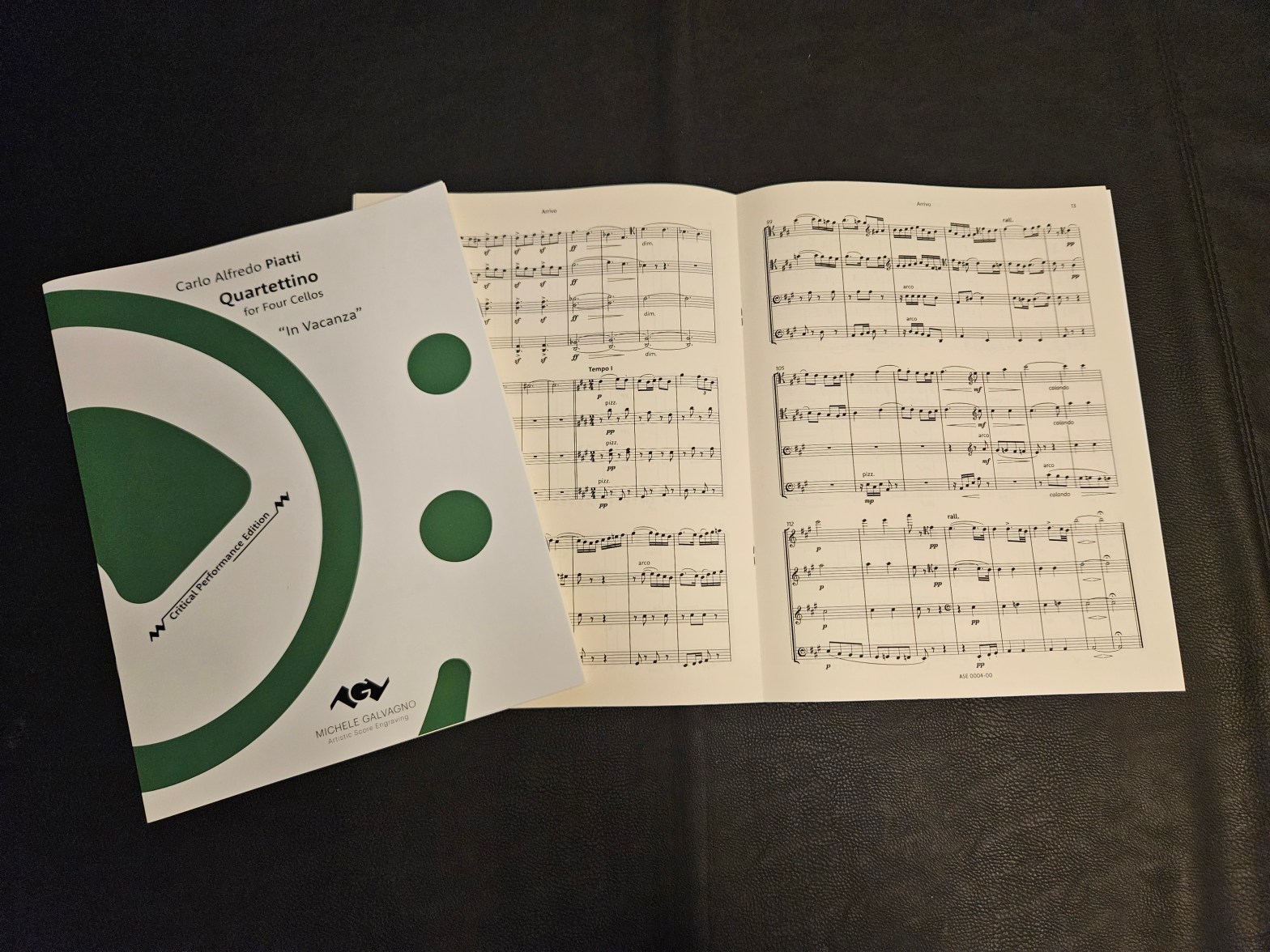
announcing the Quartettino “In Vacanza” for four cellos
This article is an expanded version of the Editorial Notes that can be found in the published edition, available digitally here, and as a physical book here. A scrolling-score video of this piece can be watched here.
Editorial Notes
Carlo Alfredo Piatti (Bergamo, 1822 — Crocette di Mozzo, 1901), one of the most pre-eminent actors of the Italian and international cellist scene of the XIX century, spent almost all of his concert career baptising England —and, more precisely, London— as his headquarters. The occasional visits to his homeland are mostly tied to his summer holidays and, during one of those, in 1878, he is offered the place of examiner at the School of Music in Bergamo.
Since that moment and for every summer thereafter, Piatti will spend several days listening, advising, assessing and grooming the young bergamasque cellists who, from 1877, had been studying under the guidance of Cristoforo Merighi (son of the same Vincenzo who had been Piatti’s teacher at the Conservatory in Milan). It is worth mentioning that, before this date, it had been impossible to study cello because of the sheer lack of a teacher.
This “perfect distiller of musical essences”—as Arrigo Boito, met in 1884, used to address him—will keep this place at the School (which became Pio Istituto Musicale “Gaetano Donizetti” in 1897) until 1901, year of his passing.
The Quartettino
Dedicating it to the young cellists from Bergamo, Piatti composes the small quartet (Quartettino) In vacanza (On holiday), a sonata-like piece in three movements for four cellos that will receive its première at the final exams in 1891. It is a simply structured piece made of catchy melodies, thick of that irony and carelessness that Piatti reckoned as a fundamental soft skill for young musicians. The first movement, Allegro con brio, bears the title Partenza (Departure), the second, Andantino quasi allegretto, Arrivo (Arrival), the third, Allegretto Vivo, Danza rustica (Rustic Dance). It is puzzling to notice the lack of a slow movement or of a Coming Back, and we can explain this only in recognising that Piatti, having come to the end of a long career, would have wanted to leave a wishing message to the younglings who were still at the beginning of their road: “may your life be as a long, endless holiday, with no slack moment; may the enthusiasm to push forward never falter you and may even old age have the cheerful rhythm of a dance”.
About the edition
The present edition is based upon the autograph (catalogue n° 8991) held at the Biblioteca Musicale “Gaetano Donizetti” in Bergamo. The quality of the handwriting in this composition is sublime and extremely clear. The needed corrections and additions have been marked in square brackets where they looked like clear omissions. Notational mistakes or adaptations to modern engraving practices have been applied without further notice. This edition comes bundled as a score with the four separate parts ready for performance. Fingerings and string markings original by Piatti have been maintained and, where necessary, updated to modern conventions.
Acknowledgements
These notes would be not be complete if I did not mention the greatest contribution of Annalisa Barzanò, who generously shared her work on the life of Alfredo Piatti. Further thanks go to the Biblioteca Musicale “Gaetano Donizetti” of Bergamo, and to its curator Fabrizio Capitanio, for granting me access to the autograph.
The Editor
Michele Galvagno
Belgrade, Serbia — August 2018
Revised and updated July 2023 for the 2nd Edition, which contains over one hundred improvements and a whole new design, more in line with recent releases.
 Music Preparation Services
One thought on “Piatti Opera Omnia — Episode 4”