An Artistic Score Engraving update from April 2026
Dear all,
Welcome back to a new instalment of the ASE newsletter. While the world appears to be crumbling to dust around us, all I can do—and, hopefully, encourage you to do as well—is to focus on spreading art, culture, education, and, above all, creativity. I am the first one who has been struggling to stay on course in this last month, sucked in by the whirlwind of news, opinions, crimes, and scandals. All this has brought a good deal of reflection, especially on that human feeling of impotence when facing events that are vastly bigger than any single one of us. I hope you will enjoy my sharing these thoughts with you, and that you will want to engage in a peaceful and constructive discussion.
What can we change?
In all honesty, when thinking about the big problems of today’s world, very little. Is it all hopeless, then? Not at all, but we need to focus on our strengths, not on objectives we just cannot reach. No single one of us can stop massacres, abuses, and crimes operated by entities around the world, neither alone, nor by participating in massive protests. What we can—and should—do, instead, is to positively influence the immediate environment around us. Be kind and helpful to our neighbour(s); respect people who are different from us; do not judge others for their beliefs. Sounds like a sermon, right? Well, it would rather not be. What I am trying to say is that each one of us should spread the positivity we can bring because our strength is in the numbers. Those deciding to do all the harm we are witnessing today are a tiny fraction of the global population. The German philosopher Friedrich Nietzsche once said that “God is dead”, and most people stopped there. What he added was that there would be two paths out of the diminishing relying on faith: (1) more culture, art, education, and creativity (active Nihilism, Übermensch) or (2) more entertainment (passive Nihilism, letzter Mensch), and I need not say what path was chosen1. The main lesson by Nietzsche is that, if we do not conscientiously select the first path, we will automatically slide into the second one, as it is the path of least resistance.
It is not too late, though—actually, it never is: we still have a choice, each one of us has one, to diminish our dependence on the entertainment industry and gradually replace the freed space with art and culture, be it music, theatre, even good cinema, reading—the Classics!—, and writing. The next step will then be to share this with our closest ones, encouraging others to do the same. If we do this, the positive avalanche effect is basically guaranteed.
Ireland has been trying to do something like this (Basic Income for the Arts, or BIA, read more here), if not for other reasons for the simple, practical fact that investing €1 in art, culture, and education had a €1.39 net return! Try to find another investment that gives this kind of return without involving slavery and environmental destruction. I bet you will have a hard time! If you allow me the connection, Ireland is essentially and institutionally betting on the superman path: giving artists the material freedom to create, instead of letting them slide into the survival job that switches creativity off.
We should push our governments, all our governments, to follow Ireland’s example, as it is factually proved that our societies will just improve all-round.
You may say I am a dreamer.
But I am not the only one…
Please do not prove me wrong!
The evolution of a job
I have always felt that one of the greatest issues in the education environment was the progressive and inexorable erosion of teachers as if they were just fuel to burn. They—we—are stuck into a vicious circle of just repeating the same thing over and over every day, with little to no evolution. Granted, every single teacher should keep studying, practicing, writing papers, participate in academic publications, but, if I look around, very few do. On average, a teacher works for 35 to 40 years in the same classroom, teaching the same things over and over again to the same kind of classes. What would be massively better in my opinion would be to reduce that time to about 10 to 15 years, after they would be assigned to training new teachers, using the experiences they have gathered so far. After 10 to 15 years of that, they would be moved to their last stage, a place at the top of the ladder where they would participate in shaping and moulding educational programs around the world. Finally, they could retire or keep consulting institutions for as long as they would like to.
This would bear incredible advantages: for starters, it would stop mixing people of massively different age brackets—and, therefore, mindsets. It would then ensure that teaching practices evolve in a structured manner, instead of mindlessly following what one’s country’s Ministry of Culture dictates—unless such place is filled with enlightened individuals.
I wanted to talk about this because this is something I am looking forward to in my engraving career too. After fifteen years of often mindlessly copying notes at a breakneck pace, I feel the urge to slow down, to breathe, to enjoy the single actions I am doing. This, however, is highly incompatible with our hyper-capitalistic system where your place in society is to be crops for locusts. You go to work (or work for clients, it is the same), you are tasked to do a lot in a ridiculously tiny amount of time, and you need to do that well, without complaining, and with rewards that are inversely proportional to your energy, time, and health investment. If you do not manage to achieve that, if you are not up to the task—or, worse, if you dare complain—, you are out. Once you are totally consumed, you are replaced, and the circle begins anew.
Things are ploddingly evolving, though. For the first time in fifteen years, a publisher I had unsuccessfully contacted several times in my natural job-seeking process wrote me back offering a job. This is interesting because it can mean only one thing: among their engravers’ pool, they have nobody wanting to take that job. Pause a while to digest this because it is important. We often—and wrongly—assume that employers contact us because they want us, our qualities, our uniqueness… Nothing could be farther from the truth: they contact us because they do not have a viable alternative at the moment. This doesn’t mean that a good working relationship cannot develop from that point onwards, it is only about how things begin. The lesson to learn here is that people are starting to refuse inhumane working conditions, preferring not to work—or to try their own business—instead. This wave started about 5–7 years ago in the corporate sector, and is rapidly spreading everywhere.
All this very long introduction to say that, a couple of months ago, I started a collaboration with a publisher with quite a long history (ca. 150 years) that is currently feeling they should do something to improve their direction. This is already remarkable, and quite rare: realising you have an issue, admitting that things are not going the way you would like them to, and wanting to change, demands respect. Knowing me from previous engraving collaborations, and knowing of my experience with major publishers, they asked me to help them soar back to the place they deserve. After the first few meetings and setting the cornerstone in place, I can only say that this is a most exciting journey and one that I am eagerly and positively awaiting.
I have also started to teach music notation software with a greater regularity. After all, I cannot engrave the entire world myself, and it is just fair that, if I can help other people improve their level, we will all gain in the long run.
NEW EDITION!
As last month, I would have many more things to tell you, but I would like to keep the mood of this update coherent so, for that, you will have to wait until next month.
A new edition has joined the ASE family, and it is an arrangement of Sergej Prokofiev’s Sonata for Flute and Piano, Op. 94 (1942–44), for flute and string quartet, by Australian composer Lee Bradshaw. The recording, with Joshua Batty and the Chroma Quartet, will be released later in the summer.
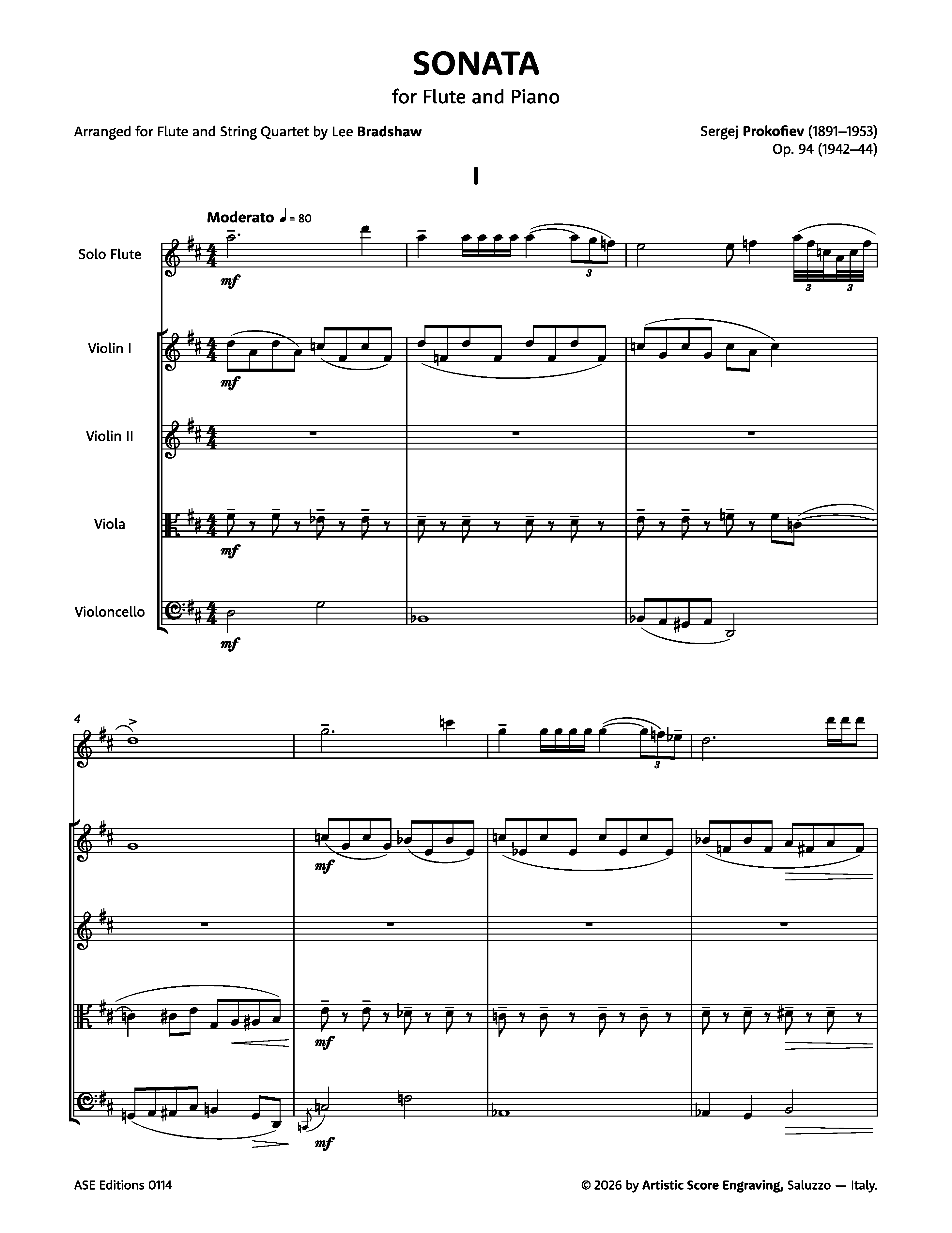
Since this work is not in public domain worldwide, I have published it only on Payhip (UK based) and not on Gumroad (US based). Learning about copyright laws has been both enlightening, embarrassing, and, ultimately, hilarious. You can find it here in digital format. The printed edition will be announced as soon as possible. With the current disruptions, shipping has increased by 30% and raw materials by a smaller but still significant margin, meaning that I have to group a few editions together before commissioning a print. Thank you for your patience!
Bottom Line
That’s it for today! Thank you for reading this up to the end and, please, share with me what you think, especially about the first two parts of this update. I read everything and try my best to reply as swiftly as I can.
You can join my mailing list to get weekly gifts and promotions; browse my editions and contact me directly for printed titles. My YouTube channel, finally, contains video renditions of most editions.
See you next month for the next ASE update. Please let me know what you are doing and where your musical adventures are bringing you.
Yours,
Michele
- This is a massive simplification of Nietzsche’s writing, please do not take this to the letter. Analyse what he wrote and find how I got to this conclusion. ↩
 Music Preparation Services