

A deeper dive into the Cyrillic alphabet
In Lesson 1, the lesson ended with a personally composed rhythm to memorise the order of letters of the Cyrillic alphabet. A few days later, I discovered a song that Serbian kids have been using for the last 30 years at least. You can watch the full video here, while I’ve transcribed the melody by ear for your convenience.

The song is much longer, and there is also a beautiful rendition of the Lisinski Music School, which I suggest you watch in its entirety. This is the equivalent of what in Italy we call “Scuole Medie ad Indirizzo Musicale” and “Licei Musicali” but, with all due respect to the existing exceptions, our general level is very far from this.
When I started to learn this, my girlfriend taught me a short sentence they learned as kids, coming from Vuk Karadžić (Вук Караџић), the reformer of the Serbian language in the XIX century):
пиши као што говориш, читај како је написано
“Write like you speak, read like it’s written”
”Scrivi come parli, leggi com’è scritto
This gets away with all the hardships you have when learning any Latin-based language such as French (cough) and Italian, where few of what you read is actually written in the same way. In the Cyrillic alphabet, every grapheme represents one phoneme. That means that every graphical sign corresponds only and always to one sound.
In its Latin transliteration, there are three double graphemes (lj, nj, dž) and five graphemes with diacritics (ć, č, ž, š, đ). The order of the Serbian alphabet in its Latin transliteration is different from its Cyrillic counterpart, as follows: A, B, C, Č, Ć, D, Dž, Đ, E, F, G, H, I, J, K, L, Lj, M, N, Nj, O, P, R, S, Š, T, U, V, Z, Ž. You can see how similar this order is to our Latin one. When you have two similar letters, the harder accent has precedence.
The surprises are not over, though, since Cyrillic also has a cursive version, used in everyday’s handwriting. Here’s my best attempt at it:
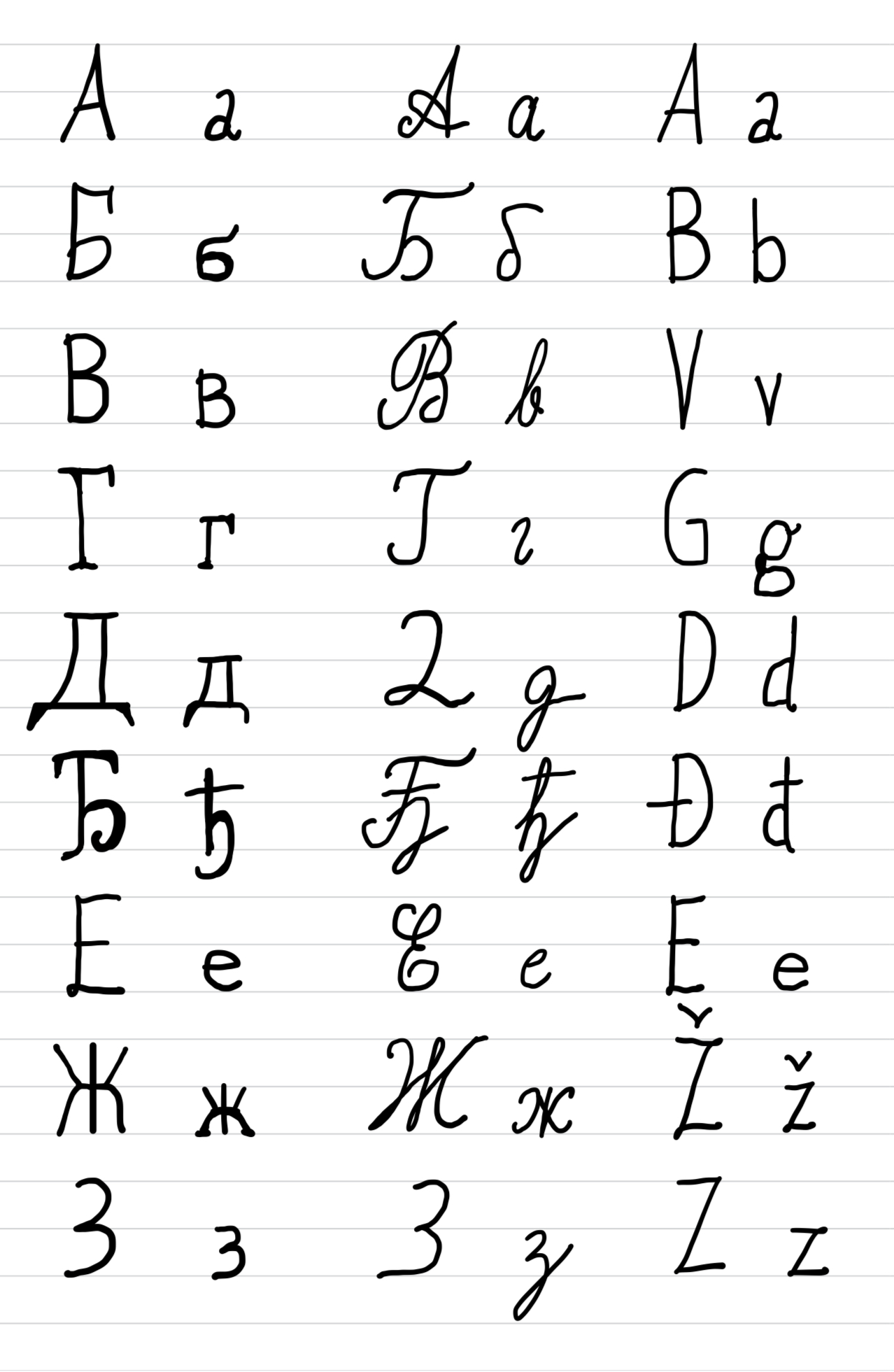
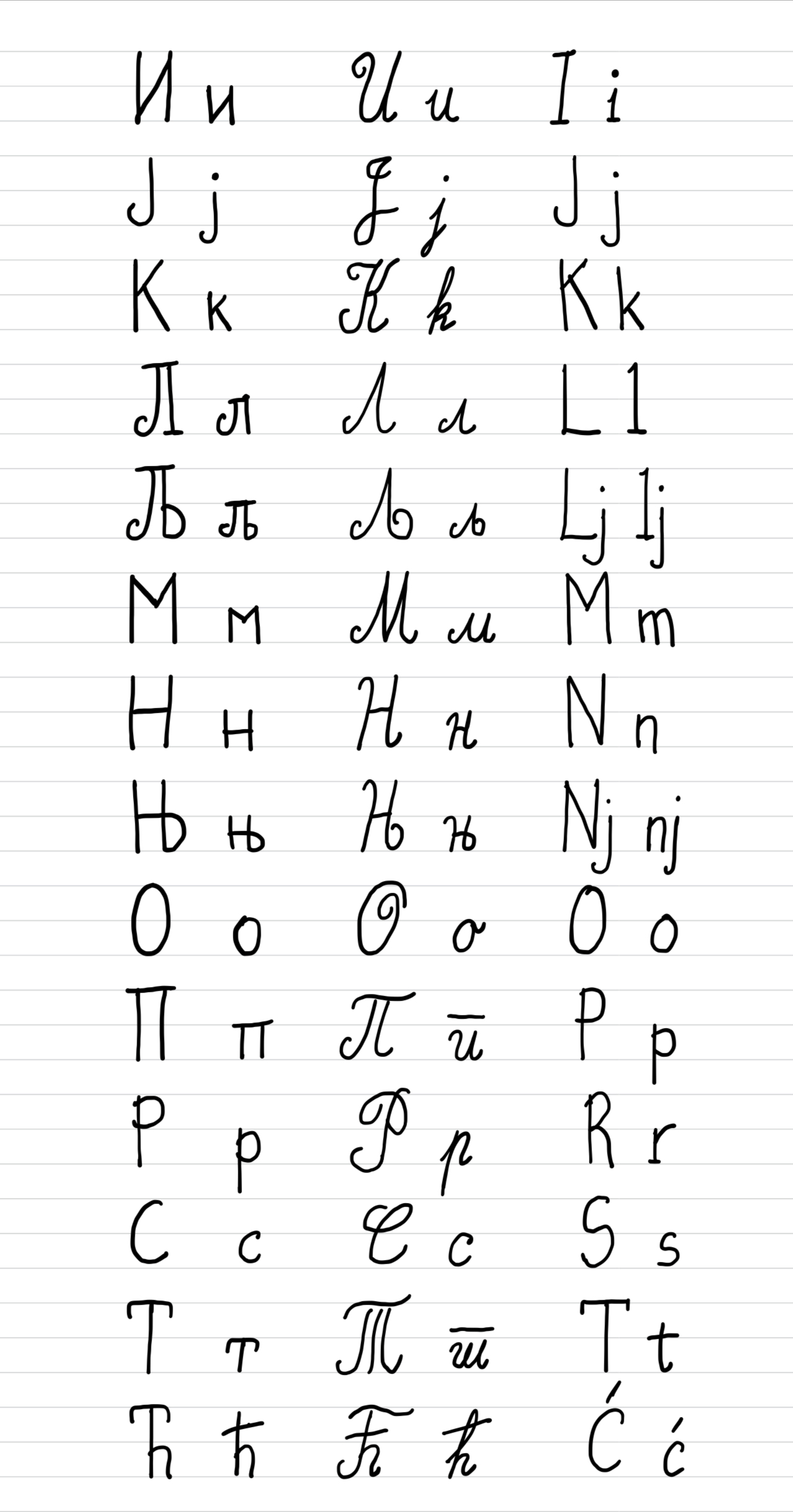

The column to the left shows the Cyrillic block letter writing (in Italian stampatello), in both upper- and lowercase. The middle column shows the Cyrillic cursive, in upper- and lowercase, and the column to the right shows the Latin equivalent.
I would like to bring your attention to a few details. To start, look at the outer columns: notice how most letters in the Cyrillic block letter writing use a smaller version of the uppercase for the lowercase (and viceversa). This is something that Latin usually doesn’t do. Compare, for example, the letter G, fourth from the top: in Cyrillic the uppercase is Г and the lowercase is г. In Latin, instead, the uppercase is G and the lowercase g. Try to find all the letters that have equal or different glyphs for upper- and lowercase.
The second detail is towards how some lowercase Cyrillic cursive letters resemble other letters in Latin cursive handwriting. For example, the letter Д in Cyrillic cursive lowercase is written as letter g in Latin cursive lowercase. These differences will prove to be quite challenging during your journey through the Serbian language, but believe me: through practice and patience, everything is possible!
Ultra-concentrated history
The basis of the Cyrillic alphabet was created during the IX century CE at the Preslav Literary School (aka Pliska) in the First Bulgarian Empire, then governed by Tsar Simeon I the Great. It is believed its creators were the disciples of the two Byzantine brothers, Cyril and Methodius, who had previously created the Glagolitic script, the oldest known Slavic alphabet. These two monks were sent from Thessalonica by Emperor Michael III in 863 AD to spread the Christian faith in Moravia. After their death, their disciples modified the Glagolitic script by introducing several Greek letters, spreading the newborn Cyrillic alphabet (named in honour of Saint Cyril) in all Slavic countries of Orthodox faith.
As mentioned above, it was not until the XIX century that Vuk Karadžić (1787–1864) reformed the Serbian language and its alphabet, giving birth to the modern Serbian Cyrillic alphabet. There’s a beautiful museum here in Belgrade, Muzej Vuka i Dositeja (Музеј Вука и Доситеја), dedicated to him and to Dositej Obradović (1742–1811), a writer who was the country’s first Minister of Education. The museum is a crucial site for understanding the revival of Serbian culture at the time of the First Serbian Uprising against the Ottoman Empire. As a teacher myself, it is moving to see how much love and dedication was poured into giving young kids the very best education they could get! If you come to Belgrade, I encourage you to visit it!
Bottom Line
That’s it for today! Thank you for reading so far, I hope you liked it!
If you like what I do, feel free to share this article with your peers.
I also have a newsletter, dedicated mostly to my activity as a music engraver and sheet music publisher. You’re more than welcome to join!
See you (hopefully soon) for another lesson, when we will face the closing exercises for this introductory unit!


2 thoughts on “An Italian cellist’s journey into Serbian Language — Lesson 3”