

Episode 7 – Notational conventions (Part 3)
Welcome back! Today we continue our journey through the notational conventions that allow you to properly engrave an opera, specifically focused on doing this in Sibelius.
Woodwinds
There’s always been an active debate regarding whether the Piccolo stave should stay on top of the other winds or in its natural place, that is, where Flute 2 lives. Doubling is always done by non-principal players: Piccolo is played by the second flutist, English Horn by the second oboist, and so on. Knowing this, the Piccolo stave should just be treated as an instrument change in the Flute 2 stave. Others, like myself, prefer the Piccolo as the top instrument, above Flute 1. Regardless of what you choose, and believe me, both solutions are equally accepted out there, use the instrument change for the stave dedicated to Flute 2, since that is what will be used for parts. Then, if you like, create an extra stave delicately uniquely to the Piccolo, and place it above Flute 1. Hide it every time it is not playing and duplicate the music from the Flute 2 stave to here when it is. In my template you will find the extra stave, but you are welcome to ignore it, or even remove it, if you would rather not use it.

I reiterate from a previous episode: always show separate staves for doubling instruments in the score, the conductor will thank you!
Brass
Regardless of the principal language used in your score, brass players have grown to get accustomed to getting their markings in English, especially when talking about mutes. When starting the piece without mute, nothing needs to be written, otherwise follow these suggestions:
- write “open” above the first note that doesn’t use the mute
- write “muted” above the first note that uses the mute
- If a specific mute is required, write an instruction at the end of the last phrase before the mute comes into effect.

- The closed (+) and open (o) sign are usually reserved for hand-stopping (at least for horns). Use it in conjunction with arrows to denote gradual changes between different states.
If any of the aforementioned conditions apply for more than one system, state a reminder in the score at the beginning of the new system (or just before the instrument entry, as a reminder), in parentheses, like so:

Strings
Division
Particular attention should be devoted to the management of divisi strings. When creating the basic template, we started with two instruments per section, one for the Tutti, and one (with two staves) for “Solo + Gli altri” division. In this case, feel free to translate “Gli altri” into the dominant language of your score (EN: the others; FR: les autres). There are, of course, countless possibilities of division, one of the most used being by desk. While I do not like it so much, Britten (or, rather, his editor) writes most divisions directly in the staff label, making its realisation in software programs unnecessarily complicated. In Sibelius, you should use Instrument changes (with all due consequences), but I suggest using player labels when the division is limited to a few bars or systems. That is, use the same approach used for brass mutes. Consistency is key, and gets you far.
When simple division is needed, write “div.” directly above the entry, and then “unis.” when unison playing is restored. If multiple instructions are needed on the same rhythmical position, write the division before everything else, e.g., “div., pizz.”. If a Solo line lasts only a few bars, you can use the Tutti stave and mark “Solo” and “Tutti” where necessary.
There’s a nice example in Britten where Violin I & II play the same part but are divided desk-wise. That is, “Violin I – desk 1” and “Violin II – desk 1” play the same thing (upper stave), while “Violin I – desk 2” and “Violin II – desk 2” play the same thing (lower stave), and so on until there are no more desks:

Technical instructions
In an operatic context, bowings are usually shown in the full score as well. While this is something I am not particularly fond of, and a practice that I would never apply to other scores, it appears that it helps save rehearsal times (in film scores this is used as well).
String instructions are also shown. If a double stop requires clarification, it is typically written on a single line, like “III & IV”. In ordinary contexts, I would write it in a stacked column.

There’s also another side to this story: while text objects such as string instructions are easily hidden/shown in score/parts, the same is not true for bowings, since for them to be correctly stacked above the notes, they need to be articulations found in Sibelius’ keypad:
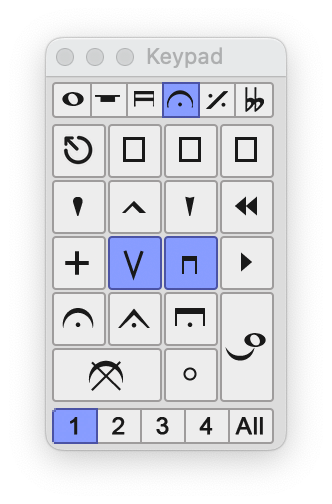
They are part of what is called a “NoteRest Object” in Sibelius programming. None of its parts can therefore be hidden without hiding the whole object. Therefore, to get bowing markings in parts only, one would need two copies of a score, one with and one without them. This is time-consuming and so it is possible that, in the past 20 years or so, best practices may have been lost due to economic reasons.
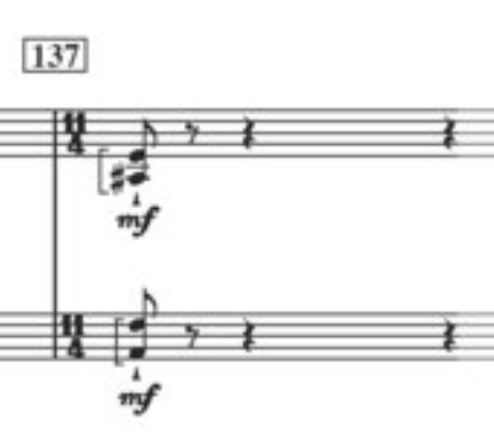
When a chord is played “non-divisi”, such as a plucked pizzicato chord, you should either write “non-div.” (but that is wordy and burdens the score) or simply use a vertical bracket:
Bottom Line
That’s it for today!
In the next episode, we will continue exploring notational conventions, covering harp, voices, and more!
If you enjoy what I do, please consider liking this article, sharing it with your peers and colleagues, and subscribing to this blog to be notified of upcoming articles. If you use an iPad and would like to improve your Sibelius experience, please give a look at my profile for MetaGrid Pro here.
I also have a newsletter that follows my publishing journey, check it out if you are interested in cello (and more) and would like to receive special gifts. You can also browse my online catalogue here.
Thank you for your time and continuous support.
See you in the next episode!
Michele
 Music Preparation Services
One thought on “How to engrave an Opera (in Sibelius) – Ep. 7”