
An Artistic Score Engraving update from early Spring 2025
Dear all,
I hope this update is reaching you in full health and in good spirits. I am relieved to simply have found the time to sit down and write this. Things have been super-packed here and I have lost the memory of when I last could sit down and read a book that wasn’t work-related.
The daylight saving change hit me hard as well, making me hopelessly sleepy during the day, and starting to wake up at sundown.
One hundred words in, and I have not yet explained today’s title, you say? Well, as you will read, I could have used the Urtext “Brother John”, but Fred seemed more appropriate. Enough mysteries, though, let’s begin!
The Gratitude Corner
This month’s gratitude corner goes to my early educators, but not for the reason you may think. They all had one thing in common: they used blackmailing as the underlying strategy of their education method. Growing up in a theoretically secular but in practice heavily Catholic country, then, brought shame into the mix. Any occasion was good for public mortification, pointless humiliation, and finger-pointing contests!
Why, then, would I ever want to be grateful for all this free suffering? The answer is as simple as it was difficult to elaborate, requiring 30 years of mental struggle to reach it: because they taught me what I do not want to be!
As soon as I realised that most—if not every—blackmail is hollow, I found my freedom and my ancestral right to be happy. To anyone suffering for similar reasons I say: try, even once, to see into their bluffs. You may be pleasantly surprised!
As someone who teaches young kids every day, I can see the effects of this kind of education on their behaviour, and I categorically refuse to give them any more suffering. Seeing my young self in them as in a mirror, I know I can be a better educator. I have to be a better educator! Granted, it takes more time, patience, and it may yield fewer results at first, but in 10–15 years, that person will hopefully be a happier human being.
Welcome back, Brother!
Getting now to the meat of today’s update, something great just happened: two major publishers have released editions of Dotzauer’s music! This is just wonderful because the more awareness is built around Dotzauer, the greater the chance that someone may notice all the work I am doing.
Brother Fred, then, is none other than our dear friend Justus Johann (John?) Friedrich (Fred?) Dotzauer. The reference to him being asleep is tied to the little to no resonance his figure (and my work on him) had received until now.
The two published editions—which I will review thoroughly in separate articles—are: the musical part of Op. 126, 40 Exercises for 2 cellos, in two separate books, by Breitkopf & Härtel (EB 9417 & 9418), and the first volume (out of three planned) of a new collection of solo studies by Bärenreiter (BA12101D). Approach-wise, they are two massively different editions, and I will have a lot to say, especially on the second one.
Before moving forward, I would like to reflect on marketing strategies. Bärenreiter seems to invest much more than their competitors in “modern” promotion, including having performers endorse their editions. When it comes to raw quality, I would always choose Breitkopf over Bärenreiter, but I admit my parameters are quite unique. Will potential customers be given a choice, though, when a single player occupies most of the promotional space?
All considered, I am thrilled to see where this initiative is going, as having Dotzauer’s music known and played more can only be a good thing for all of us.
NEWS
… from the Publishing World
There were no new editions published this last month. I am working hard towards three new titles that need to be released in June and cannot be late. At the same time, I am keeping a Dotzauer edition always in the shipyard so that the project can move forward (you know the rhyme: “a Dotzauer a day keeps the doctor at bay!”). Finally, I have noticed how my catalogue is growing longer while leaving behind editions I started to work on but never completed. From now, I will dedicate at least 25% of the available time to reviewing old editions or to bringing abandoned titles to life. If one wants to build a pyramid, after all, strong foundations are needed.
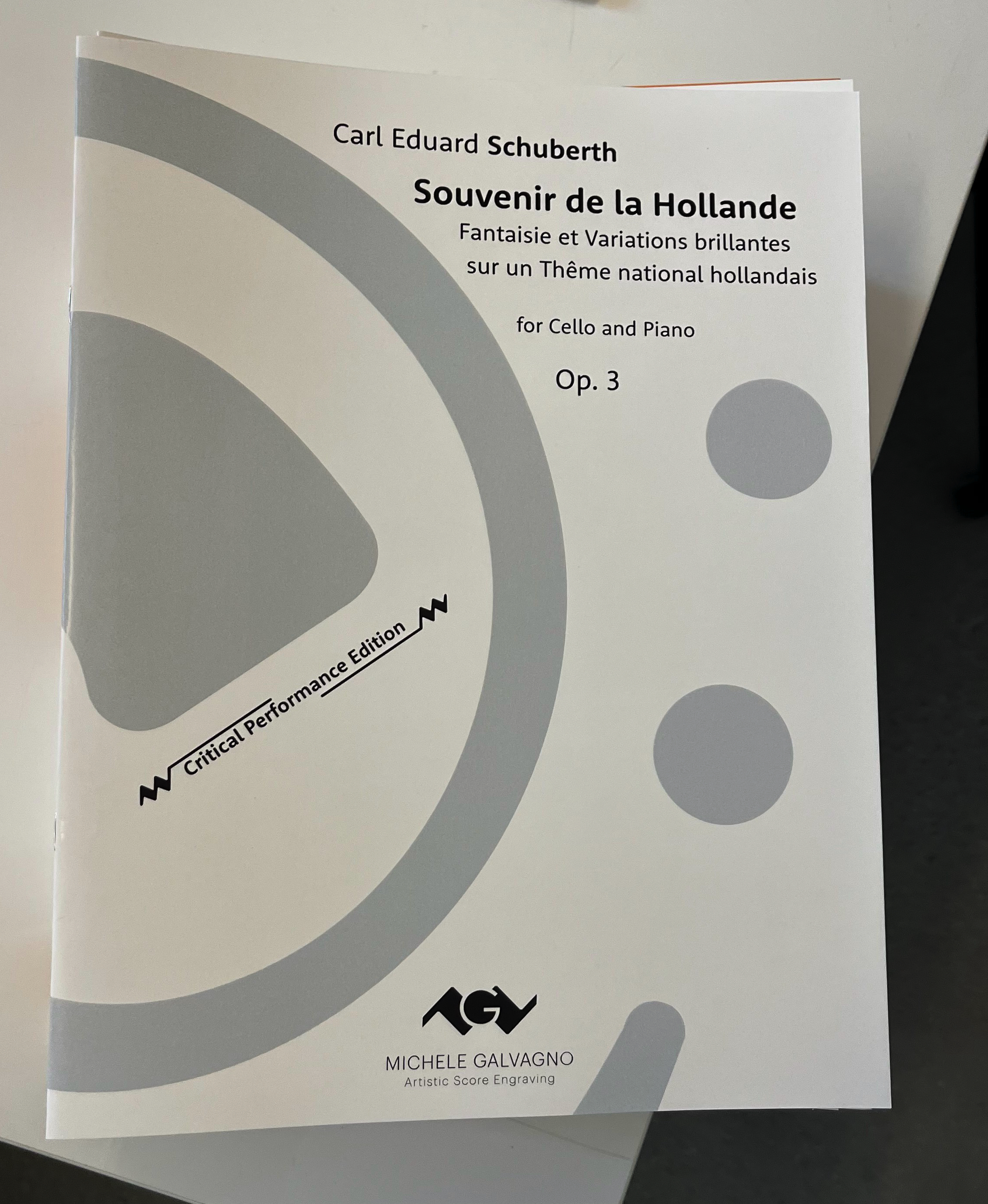
Four new editions have been printed, but I have not received the promotional pictures yet. All I can share is the unboxing check that the distributor kindly sent to me:



I have also realised an unboxing video for the Projeto Puccini. Please let me know what you think of it.
My edition of Bach’s First Cello Suite with piano accompaniment by Piatti is now being used in an academic research on Bach’s bass line. The writer was also so kind to point out 2-3 possible mistakes to me, and I am deeply grateful for them taking the time to write the report.
… from the Printing World
Printing is becoming increasingly difficult and expensive. Moreover, fewer and fewer people seem to care about it, vastly preferring a digital file. Granted, it is handier, it occupies less space, it doesn’t age, and it is usually cheaper. On the other hand, the largest available tablets have a 13-inch (Apple) or 14.6-inch (Android) screen, meaning that music will be forcefully smaller. That will not be a problem for very young or perfectly sighted readers, but for everyone else—raise your hands, glass-wearers!—it will be quite uncomfortable.
The first studies on the degrading effects digital tools have on our brains have recently surfaced, and they show how our understanding of a written text is much lower when reading on a screen.
I am the first one to (ab)use a big iPad Pro for practising and teaching, but:
- I generally own a paper copy of every score
- I know by heart most of the repertoire I teach, so the screen is only there to annotate the current student’s copy
- I practice on screen only when I need to annotate the score several times
Recently, then, an incident occurred: I was offered a sample copy from one of my printers, saying that I would only be charged for the shipping. Fast-forward one month, and I was charged quite handsomely for that copy. I eventually managed to hold my ground, but it was a very uncomfortable situation. Now, possibly as expected, I received a 10% increase to the next printing quote as a present. I guess that’s the price of not giving in to blackmail.
… from the Engraving World
Things are moving very fast, so that the most complex task is to organise the different assignments in a way that every customer is happy with both quality and timing.
Some of the proofreading work that I weekly publish received special praise, leading to an assignment I deeply enjoyed working on. I truly believe that, without proofreading, the quality of my editions would be around 40% of what it is now.
Preparing orchestral parts had never been my forte, but the last few months obliged me to step up my game. My focus had always been on beauty over practicality. Recent assignments, though, taught me how much good page turns are the topmost priority, no matter the cost. It took me a while to get used to this approach, but I feel much more confident now.
What’s next?
There are far too many things I would like to do and that just do not fit in my daily schedule. More editions, more educational materials, perhaps some videos of me discussing some of the cello topics that are dearest to me. I am truly struggling, though, and all I can do to keep my head from flying away is to reduce the number of tasks to be performed in a given day.
I hope to get some more manageable time in the coming weeks.
Bottom Line
Thank you for reading up to the end. As always, I value your input, comments, and feedback.
You can join my mailing list to get weekly gifts and promotions; browse my editions, and check what’s available for print in the HNE Store.
My YouTube channel, finally, contains video renditions of most editions.
See you… next time for the ASE update. I hope it will be soon. Please let me know what you are doing and where your musical adventures are bringing you.
Musically yours,
Michele
 Music Preparation Services