
Celebrating the life and works of Justus Johann Friedrich Dotzauer
To honour Dotzauer’s 242nd birthday today, I am publishing an as thorough as possible biography of the life of this beloved master of the cello. This aims to be one of the most comprehensive resources on Dotzauer’s life in the English language. As one could expect, most material on Dotzauer is in German language, and I have done my best to translate, paraphrase, and adapt the existing sources for modern reading and enjoyment.
Here are the main sources used for writing this article:
- Brückner, Georg. “Dotzauer, Friedrich.” In: Allgemeine Deutsche Biographie, Vol. 5 (1877), pp. 365–366. Historische Kommission bei der Bayerischen Akademie der Wissenschaften. Wikisource Link
- Beer, Axel & Krause, Bernd. “Dotzauer, Justus Johann Friedrich.” MGG — Die Musik in Geschichte und Gegenwart, Vol. 3 (2002), pp. 1338–1342. Bärenreiter-Verlag.
- Wagner, Erich. “Dotzauer.” In: Bedeutende Männer aus Thüringer Pfarrhäusern, Berlin: Evang. Verl.-Anst., 1957; Dresden: SLUB, 2018; pp. 88–93.
- Allgemeine Musikalische Zeitung (various issues, 1805–1860).
Early Life and Musical Training
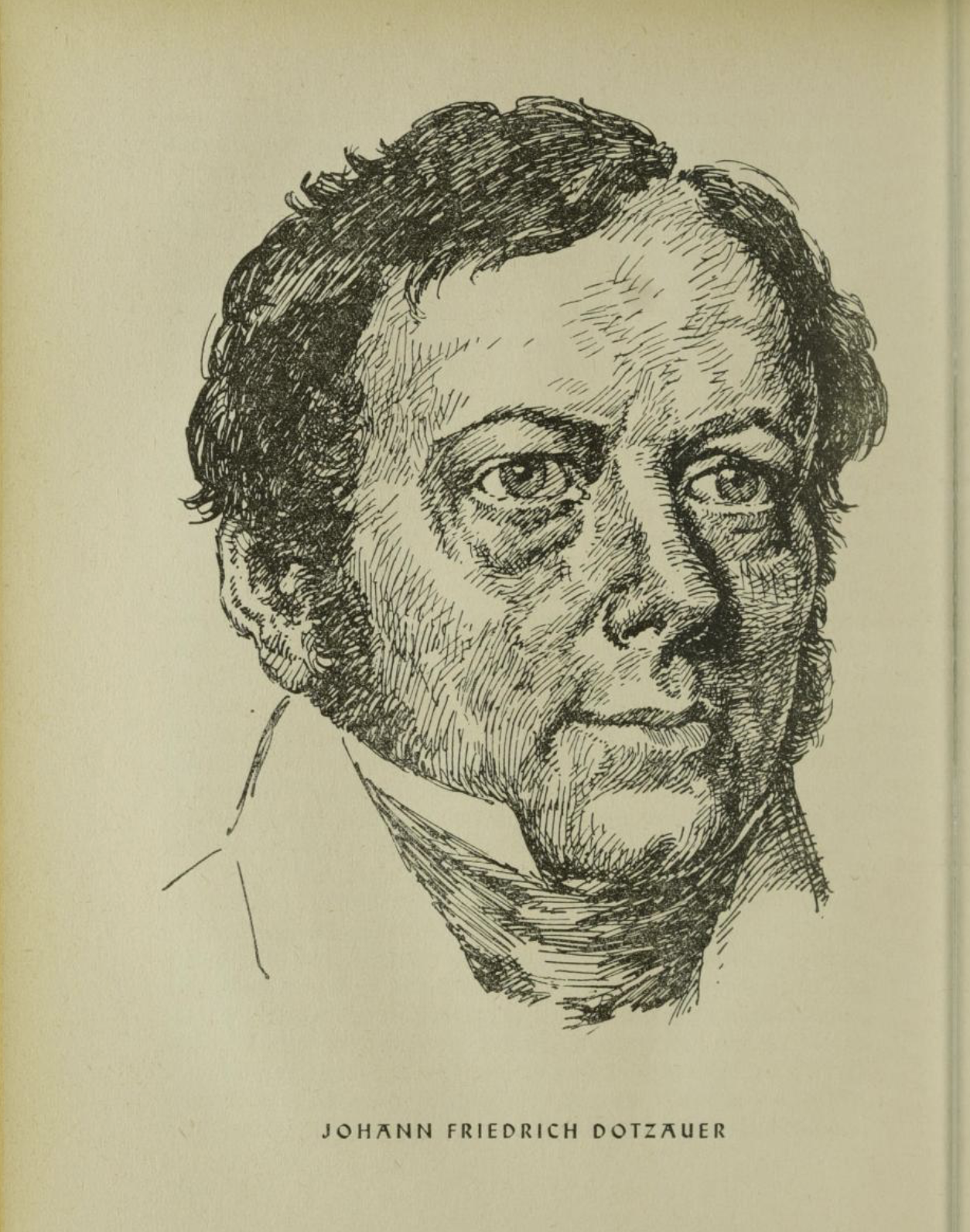
Justus Johann Friedrich Dotzauer was born at around half past nine in the morning on the 20th of June 1783 in Häselrieth, near Hildburghausen in today’s Turingia, Germany. Third son of the local pastor, Justus Johann Georg and his wife Elisabetha Margaretha, born Großmann from Harras, J. J. Friedrich was baptised two days later during the afternoon service on St. John’s day, at the presence of three godparents: the maternal grandfather Johann Nicol Großmann, the commissary Christiana Hennerietta Lettermann from Hildburghausen, and Johann Georg Henne, Georg’s brother-in-law, court and country organ builder in Hildburghausen.
Music was pursued enthusiastically in his father’s house; after all, the figure of a Protestant pastor was difficult to imagine without serious music cultivation. The musical talents of the young Dotzauer soon became evident, prompting his parents to use all their means to nurture them. This meant giving him a solid general music education to begin with. He went on to live with his uncle, J. G. Henne, in the near Hildburghausen. There, the Court Chapel members Johann Andreas Gleichmann (1775–1842) and Johann Peter Heuschkel1 (1773–1853) taught him to play the piano and the violin. Later on, he received lessons in composition from Johann Caspar Rüttinger (1761–1830), a student of Johann Christian Kittels (1732–1809) who, in turn, had been a direct student of Johann Sebastian Bach (1685–1750)2. He also learnt how to play the French horn and the clarinet—the first of which would receive a now lost double concerto for two horns and orchestra, while the second would get a Divertimento for clarinet and orchestra, Op. 68).
It would be thanks to the town’s blacksmith3, a skilled double-bassist, though, that the young Friedrich would develop his interest in the lower string instruments. He learned the basics of the double-bass from the blacksmith and then received his first cello lessons from Hildburghausen’s court trumpet player Paul Heßner (? – ?) around 1793. He later said that, among all the string instruments, the violoncello evoked for him the unforgettable, soulful alto voice of his beloved mother, prompting him to devote himself exclusively to this instrument. Dotzauer’s dedication and talent were so great that, already after one year of practice, he gave a public concert with the local orchestra. Such skills would not go unnoticed for long, prompting Johann Jacob Kriegck (1750–1814), a respected cellist, student of Jean-Louis Duport (1749–1819) in Paris (1774), and ducal concertmaster in Meiningen, to accept him in his class from 1799. Dotzauer would always nurture a tremendous respect and devotion for Duport’s teachings, mentioning him several times in his first Violoncello School, Op. 65 (1824).
First professional experiences
In 1801, the then 18-year-old Dotzauer obtained his first employment as cellist at the Coburg Hofkapelle,4 under the baton of Georg Laurenz Schneider (1766–1855)—the founder of the Hofkapelle in Hildburghausen. By the end of 1805, he became a permanent member of the Gewandhausorchester in Leipzig, thanks in no small part to the mediation of the publisher Ambrosius Kühnel (1781–1813)5. In Leipzig, Dotzauer shaped his musicianship, receiving growing appreciation as a composer both from the audience and from the critics. His reputation must have preceded him there, though, since the reviewer of the Leipziger Allgemeine Musikalischer Zeitung (AMZ) felt compelled to congratulate the orchestra on his employment:
Mr. D. is an excellent player: his tone is secure, definite, pure and always pleasant; his delivery extremely engaging, fine and delicate; His skill is significant…, he is committed as a permanent member of our orchestra, which has made a real acquisition of him6.
Together with violinist Heinrich August Matthäi (1781–1835) and Bartolomeo Campagnoli (1751–1827)—the two concertmasters of the Gewandhausorchester—, and the violist/cellist/organist Johann Georg Hermann Voigt (1769–1811)7, he established the Gewandhaus–Quartett, a string quartet ensemble that is still active to this day.
During a visit to Berlin in 1806, Dotzauer had the chance to get in closer contact with Bernhard Romberg (1767–1841), the leading German cellist of the time, and whose playing and compositions would influence him for the rest of his life. In a letter to the publisher Kühnel8, several years later, he would refer as to having met “his God” in Romberg. This meeting seems to have shaken Dotzauer deeply, convincing him that what he had achieved so far was not enough, and prompting him to take a six-months-long vacation to further perfect himself. Now, sources do not agree on whether he actually studied with Romberg or he simply took time off to practice by himself. The AMZ (1806, No. 14) mention “his stay with Romberg in Berlin” but the most authoritative source on the Romberg family doesn’t list Dotzauer among Bernhard’s students. The entry in the MGG encyclopaedia even mentions Romberg refusing to take Dotzauer on as a student, given his already advanced level. If we analyse Dotzauer’s playing style and pedagogical output, we can lean towards Romberg certainly exerting an enormous influence on the younger cellist, perhaps even allowing Dotzauer to play for him, without although ever becoming his long-term teacher. What we know is that Dotzauer mastered and performed most of Romberg’s output for the cello, therefore strengthening and refining his playing and readying to become “a cellist, as there are now only a few”9.
From an 1808 note in the AMZ, we can deduce that Dotzauer declined several calls to other cities:
May he also always remain faithful to us and not long for larger places where he would probably find more external advantages, but would certainly also be more distracted by the confusion and less noticed because of the competition10.
During 1808, he would marry Johanne Christiana Kreße (1784–1861) and his first child, Justus Bernhard Friedrich (1808–1874), would be born. He remained in Leipzig for three more years but, when the Dresden Hofkapelle called in 1811, he could not refuse. It was not easy for him to leave Leipzig, especially for personal reasons, but, as a true artist, he had to strive to expand his sphere of influence and gain new experiences. We can assume that it was not “external advantages”, but rather higher considerations that were decisive in his decision; “competition” is essential for an artist to prevent him from growing satisfied with what he has achieved and, therefore, declining. In the report on the farewell concert that Dotzauer gave, the pride of Leipzig’s musical circles to have been able to count such a gifted artist among their own shines through once again:
Mr. D. came to us several years ago as a very young man, who already showed unmistakable talent and a thorough education for music in general, but particularly distinguished himself as a very accomplished, expressive and engaging cellist; and soon, through these artistic advantages, as well as through his respectable character as a human being, he earned an excellent reputation from everyone who got to know him… So, as much as we begrudge his possession to the art-loving Dresden… we must, at the same time, sincerely mourn his loss because, both as a concert– and even more so as a quartet–player, Mr. D. will be very difficult to replace11.
Moving to Dresden
Dotzauer would leave the city to which he would “owe all his fortunes”12 and move to Dresden in the first months of 1811 to work for the Hofkapelle. He would become principal cellist in 182113 and keep that role until his retirement in 1852. Already in his first year there, he would help manage a “Quartet-Akademie”, dedicated mainly to the works of Haydn, Mozart, and Romberg, and that would become a stable institution in the city’s musical life.
In Dresden, Dotzauer experienced his most florid period, receiving the title of Royal Saxon Chamber Musician, and reaching his highest level of mastery. He made his name famous through performances both domestically and abroad, where he was unanimously celebrated—especially in Prague, where he would be a regular guest. He was also able to witness important events in the history of German opera, playing under the baton of Carl Maria von Weber (1786–1826), Heinrich August Marschner (1795–1861), Carl Gottlieb Reißiger (1798–1859), and Richard Wagner (1813–1883). We can rightly assume that he participated in the premieres of Rienzi (1842), The Flying Dutchman (1843), and Tannhäuser (1845).
In December 1811, his second child would be born, Karl Ludwig (1811–1897), and he would regularly organise and play in concerts with both his sons. He died in Dresden on March 6th, 1860, and I would like to share an obituary notice from the morning edition of the Stettiner Zeitung14:
Science, art and literature
On March 9th, the musician J. J. F. Dotzauer, who died there on March 6th, was buried in Dresden. He was one of the most excellent violoncellists of his time, and no less famous as a composer and teacher of this instrument. Dotzauer was born on June 20, 1783, in Hässelrieth [sic] near Hildburghausen and was appointed to Dresden in 1811. He wrote an opera, ‘Graciosa’, five masses, a symphony and also around 180 works for his instrument.
Dotzauer’s Playing Style
Browsing the relevant reviews in the Allgemeine Musikalischer Zeitung, we can see how they almost unanimously say that, in Dotzauer, we are seeing one of the most important cellists of the last century. They praise his perfect technical mastery of the cello and his beautiful singing tone in the cantilena. At the same time, Dotzauer’s playing was characterised by grace and composure. Still, at the beginning, critics wished that he had even more of “what the current artistic language calls great playing”15. While we encounter certain less favourable assessments, they should be considered isolated, and he was particularly appreciated as a quartet player. For Dotzauer, virtuosity and brilliant playing were never an end in themselves.
Students & Legacy
Dotzauer’s firstborn son, Bernhard, would grow to become an accomplished pianist—also writing interesting pedagogical works—and serve in Hamburg from 1828 until his death in 1874. He received the title of Ducal Saxon-Altenburg Chamber Musician and, curiously, was also a skilled conchologist!
Among Dotzauer’s many cello students, we can list:
- His son Karl Ludwig, who would be invited by Louis Spohr (1784–1859) to be principal cellist of the orchestra in Kassel.
- Karl Ludwig Voigt (1792–1831), one of the few known students of Dotzauer in Leipzig, he would take his master’s place there and in the Gewandhaus Quartet after 1811. He left compelling pedagogical works, still unpublished to this day.
- Friedrich August Kummer (1797–1879), another main pillar of the Dresden Cello School, he would join the Dresden orchestra (as an oboist first!) and would eventually take Dotzauer’s place as principal cellist in 1852. Let’s just imagine for a moment that first cello desk in the Dresden Orchestra with the gift of hindsight…
- Carl Drechsler (1800–1873), principal cellist in Dessau from 1826.
- Carl Eduard Schuberth (1811–1863), a most skilled and flamboyant artist, he would move to St. Petersburg to effectively found the Russian Cello School, his most famous student being Karl Davydov (1838–1889).
Something we usually tend to forget is that no public music school existed at the time. Even the Hochschüle für Musik “C. M. von Weber” in Dresden opened as a private institution in 1856 before eventually going public. All these students, thus, took private lessons from Dotzauer and—some sources say—even lived under their teacher’s roof during their apprenticeship. This is not difficult to believe if we compare music making to any other artisanal craft, such as painting and sculpting, where young apprentices lived in their masters’ studios.
Dotzauer’s legacy can be seen from the genealogical tree of the Dresden Cello School:
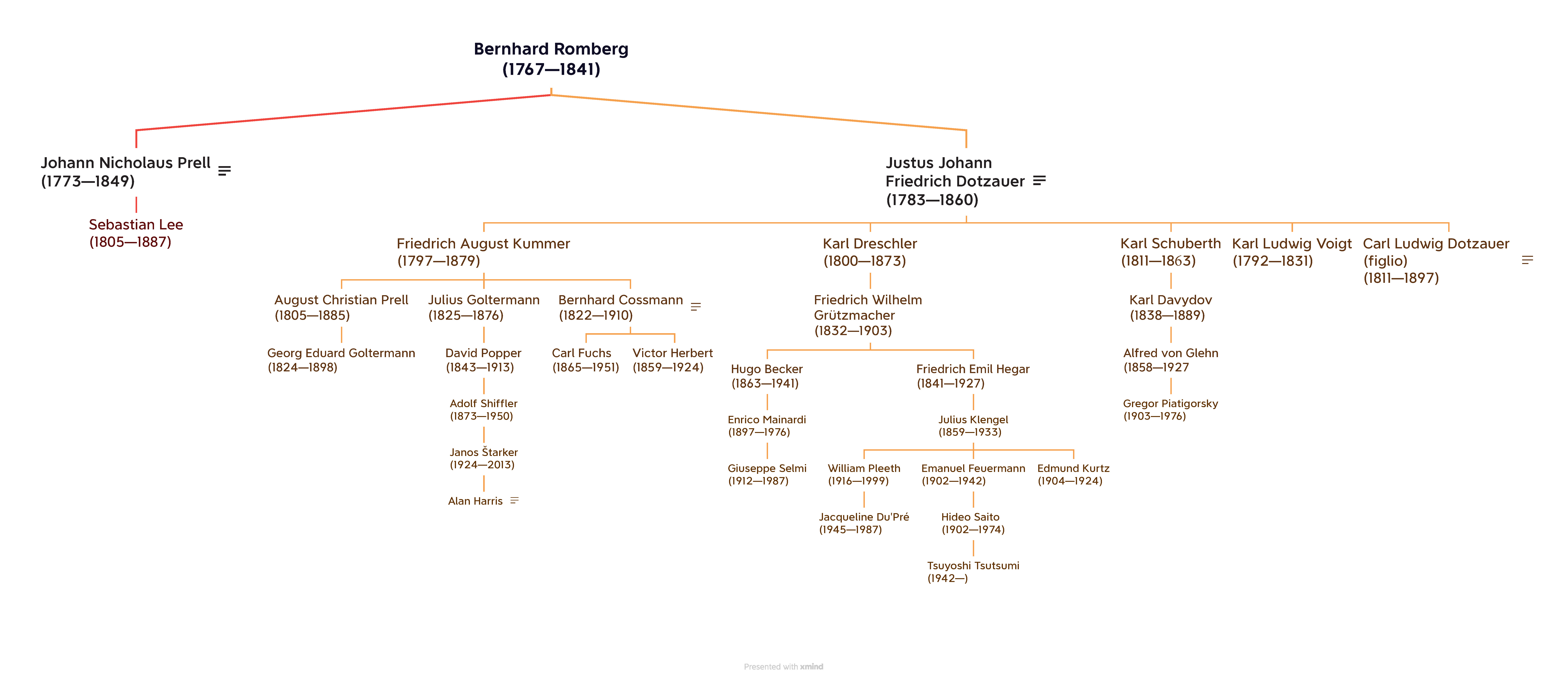
From Kummer, we would get to Cossmann, Goltermann (the one of the famous concerto in G major), the other Goltermann who taught Popper, to Starker! From Drechsler we would get to Grützmacher, then Becker, Mainardi, Selmi on one side and Klengel, Pleeth, Feuermann, Du Pré on the other. From Schuberth we would get to Davydov and Piatigorsky and, through Davydov’s student von Glehn, to Rostropovich, Maisky, and Gutmann.
Compositions
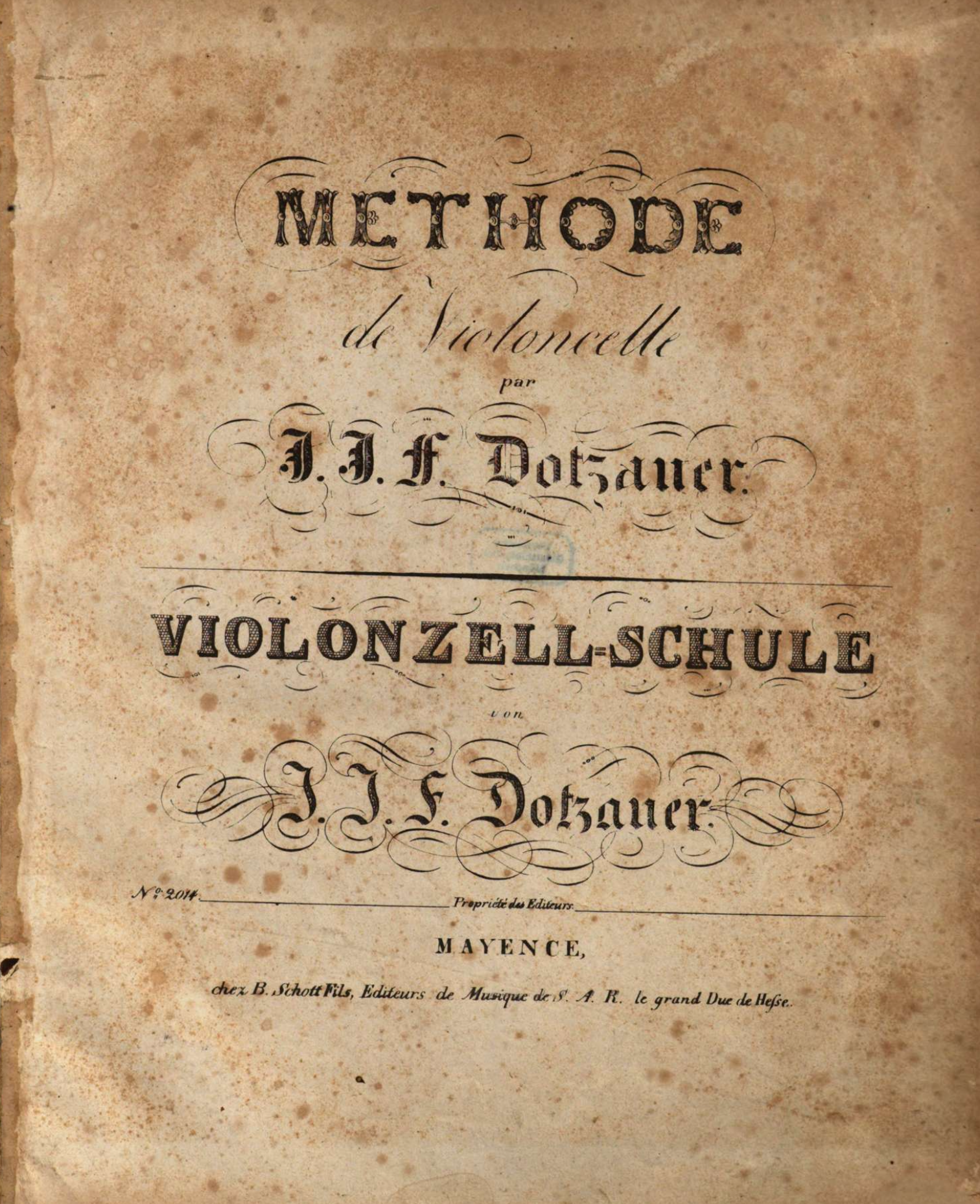
Being a composer at the time was not something extraordinary as it may be today: every single musician received a thorough and rigid training in harmony, counterpoint, and formal writing. Dotzauer’s early formation blossomed in a most fruitful career as a composer, appreciated throughout his life16. In the foreground we clearly have his immense catalogue of cello works: four schools, nine concertos, three concertinos, two-hundred-and-fifty solo études, three-hundred-and-thirty duets, several solo works. His chamber music was greatly appreciated by his contemporaries, reminiscent of Haydn in the beginning (in the first string quartets), and anticipating Schumann or even Brahms towards the end (in the piano trio). He wrote more than twenty string quartets, corresponding in the form to the four movement classical structure, with large-scale sonata-form movements and densely elaborated developments. Stylistically, they can be approached to Spohr’s production. What is worthy to mention is his careful elaboration of voice leading, where the first violin and the cello do not have prominent roles compared to the other voices.
Of his major orchestral works, most sadly lost nowadays, we count a Grosse Symphonie in d-moll to which the AMZ dedicates a four-page review17, at least one Overture, five Masses, and the opera “Graciosa”, based on the drama “Hedwig, the Bandit Bride” by Theodor Körner. This work, which had its premiere on November 2, 1840, in Dresden, achieved a respectable success, but proved to be unviable and was removed from the program after a few performances.
Although most of his works are rarely played today, it is clear how he tirelessly strived to find new ways of using his instrument. Working against the lack of variety in existing study material, he succeeded in making this genre more interesting and pleasing by paying greater attention to melody and harmony—Bach’s influence through his training with Rüttinger can be felt throughout his production. In his material, Dotzauer proves himself a systematic pedagogue who doesn’t merely aims at creating the best virtuosos, but rather providing them with a complete and fundamental training of the highest standards of his time. That’s why his production still forms the indispensable backbone of practice for every cellist who takes his art seriously.
He had plenty of opportunities to demonstrate these principles in his regular compositions, including several variations which—following the trend of the 1820s—mostly used themes of famous operas. His high level of “performing culture”18 is evident in his works for cello and orchestra where the soloist part, while certainly being challenging, it is never prohibitively difficult and result in spectacular fireworks that are literally composed for the instrument.
The practicality and the delightful, these two considerations that this composer always unites and the precise knowledge of his instrument make his works equally appreciated by students and amateurs19.
The sources mention how, until today, a detailed study of his whole output did not exist, and how deplorable it is that almost no one of his concert pieces are part of the current repertoire, let alone being available in practical edition. That’s what the Dotzauer Project is about, and it is my life goal to keep promoting Dotzauer’s music so that it regains the stages where it rightly belongs.
Conclusions and acknowledgments
Dotzauer was clearly a beloved human being before even considering all his artistic skills, pedagogical and musical contributions. We should remember him as the spark that ignited the fire that would shape cello playing into what it is today. We should also remember his main lesson: through dedication, practice, passion, and a good heart, there are no boundaries that can stop us.
At the end of this massive article, I would like to deeply thank Dr. Bernd Krause of Büro für Geschichtswissenschaften, and Dr. Axel Beer of the Johannes Gutenberg Universität Mainz, for their help in gathering its ingredients. While all writing and translations are my own, their encouragement in deepening my research, in constantly striving to seek more sources, more data, more everything, was and is crucial to the everyday activities of the Dotzauer Project.
I hope you got something useful out of this reading and that you will gain a renewed interest in Dotzauer’s music. Please don’t hesitate to get in touch to discuss anything you read here and your personal experience with Dotzauer and more.
You can join my mailing list to get weekly gifts and promotions; browse my editions, and check what’s available for print in the HNE Store.
My YouTube channel, finally, contains video renditions of most editions.
- Heuschkel was also the piano teacher of Carl Maria von Weber. ↩
- Bach’s influence can be clearly seen—and heard—in most of Dotzauer’s compositions where counterpoint is the absolute protagonist. ↩
- It has not yet been possible to gather enough information on his identity. ↩
- Early sources refer to him playing in the Meiningen orchestra, but this is incorrect. ↩
- He would be crucial in the publication of some of the earliest works by Dotzauer, namely his Op. 2, 10, 17, and 19. ↩
- Allgemeine Musikalischer Zeitung January 1806 No. 15 ↩
- His son, Carl Ludwig (1792–1831), would study cello with Dotzauer and take his place in the Gewandhaus Orchestra when Dotzauer moved to Dresden in 1809-10. ↩
- Dresden, December 18, 1811. Leipzig Saxon State Archive, Bestand Musikverlag C. F. Peters 495. ↩
- AMZ, ibidem. ↩
- AMZ, 1808 No. 31 ↩
- AMZ, 1811 No. 13 ↩
- Letter to Kühnel, Dresden, April 16, 1811, ibidem. ↩
- Certain sources state that he would be appointed principal cellist already in 1811, but this appears to be incorrect. ↩
- This was the most important daily newspaper in the Pomerania region, published between 1755 and 1910. This entry is from the Morgen–Ausgabe Jg. 105, No. 141 from March 23, 1860. ↩
- AMZ, 1806 No. 27. ↩
- Most if not all reviews of his compositions contain, beside the praises, the phrase “as we would expect from him” in some form, showing to what high standard Dotzauer had spoiled his audience with. ↩
- AMZ 1838, No. 20. ↩
- MGG, see reference above. ↩
- AMZ, 1840 No. 51. ↩
 Music Preparation Services