
An Artistic Score Engraving update from July 2025
Dear all,
I hope this update finds you well and that you are successfully coping with the summer’s heat. I, for one, have been struggling with it, so, since every movement costs a considerable amount of energy, let’s get started.
The Gratitude Corner
We have recently landed in Belgrade, Serbia, and, about one year ago, I expressed my gratitude to the people here for making me feel at home and welcomed—often more than in my own country.
Now, I would like to extend my gratitude to all the trees that are still standing here. In Italy, every occasion has been good for politicians to gather consensus through cutting trees, avidly blind to the dire consequences. Here it is all so green, florid, with low-humidity air (40-50% against 70-80% in NW Italy) and early sunrises (which I love), so much so that, sometimes, it looks like a little corner of paradise.
I am fearful of what is brewing in the hearts and minds of people, though, both here in the Balkans and in the wider world. Hoping things will stop and peace and love reign supreme would be utterly naïve, but, at the same time, it is so frustrating that we—the ordinary people—seem unable to bring any meaningful change.
The realisation!
Ever since starting this research and publishing initiative, I have been forced to neglect my cello because of sheer lack of time. The first wrong assumption was that players would have been attracted to my editions, purchased them, and performed/recorded them. This was also fuelled by someone who contacted me a couple of years ago saying they were interested in recording the Dotzauer’s duets. While that may still happen, the trail has now grown completely cold.
Only recently, then, I hit my nose (hard) into the truth’s wall:
- We players are mercenaries by definition, and no one will purchase a score and invest into a recording of an unknown piece if they do not see a serious ROI chance.
- The music I focus on was written by second-rate composers; players will not want to risk their time to learn a new, often difficult, piece that will be difficult to sell. Beethoven & Mozart are a much safer bet!
A recent chat with a recording agent finally opened my eyes:
If you gift the score to the players and pay them and the recording team north of € 2-3000, you will be able to start. Otherwise, forget it.
What does this all mean in practice? It means that no one will record my music if I do not start first. I need to show that I believe in it, take the risk, and put my face on it. While I cannot record chamber pieces alone, everything solo or cello duet is well within my possibilities.
Armed with that knowledge, in mid-June I started to record the first batch (56!) of pedagogical videos for my students; this allowed me to get comfortable in front of the camera—I didn’t expect to like it that much—and to get a process rolling. Once these videos are processed and published, I will move forward to other pieces.
What is most important is that, for once, I am not expecting any positive reaction, let alone the gratitude of my students. I am doing this only because I believe that, had I been provided with such resources in my early student’s years, I would surely be among the top-10% cellists in the world now. Sadly, the first seriously useful instructions on how to play the cello well and in a healthy way came when I was 19 years old—much, much too late for achieving anything. I am therefore now passing my knowledge down so that even 4-year-old toddlers playing their first D-major scale will be able to see how this should be done right, what the priorities are, and what mistakes to avoid.
Another inspiration for doing this comes from what Paul Hudson—my Swift programming mentor back in the day—used to tell us, I paraphrase:
If you do something you find useful for yourself, you can bet that at least 100.000 people around the world will find that useful too!
Perhaps the numbers in the classical music world in general and in the cello world in particular are smaller, but I believe the global concept still works.
NEWS
From the Personal World…
One of the reasons I have failed to publish this newsletter with regularity during these last months is that I have constantly felt in a low-battery state. I would constantly struggle to cope with everything that needed to be done, both in my work and in my daily life. I cannot say to have a real problem with organisation because when you start at 8 in the morning and at 11 in the evening you are still going, and you do that for six days a week, and still the to-do list is not looking much better, perhaps the problem lies … in the to-do list itself?!
I am now grateful that the school is over for the summer, as I do not think I could have coped with certain aspects of it for much longer. I greatly enjoy teaching; it’s the surrounding things that erode my resilience!
During the month of May, I experienced a few cases of planned obsolescence in tech and also a lucky stroke. Both my toaster and my professional 28-inch display broke, the first with a nice electricity spark and the second just refusing to turn on. Both of them broke within six months of their expired warranty of two years. Luckily for me, when purchasing them, I had added an additional coverage, and I was therefore able to get some money back for both products. When I will be back in Italy in September, I will complete the hunt for a new display (I’m eyeing some BenQ units up). Finally, after almost 7 years of faithful service, I brought my 2018 iPad Pro in for repair, asking for a battery replacement. They initially told me that this service was not possible on my model and that, instead, for the price of the battery service, I would get a new or refurbished copy of the same device. Cool, right? When I got back to the Apple Store three days later to fetch the new device, I noticed a different camera unit on the back of the iPad. The Apple employee told me, I paraphrase:
Ah yes, we had to perform an upgrade for you since there no longer were any copies of your model available. So we gave you the 2020 model!
I walked out of the Apple Store with a big smile on my face, but also with a careful wariness that all this too-good-to-be-true luck could soon be balanced by Karma!
From the Publishing World …
Another fundamental realisation struck me in these last, enlightening months. What brought me to that was a simple event: digital sales dropping to almost zero, and physical sales suddenly soaring. My editions focus on unearthing music that I, personally, believe to have been unjustly forgotten. They consist of locating the available sources, rebuilding a modern score, writing scholarly research, and then publishing each new title.
Active performers (need to) have a single goal in mind: finding new occasions to perform. If performing second-rate works would bring them that, they would do it, but, sadly, it doesn’t. What brings them concerts are the big names and, sometimes, very rarely, some contemporary “famous” work. Premieres seem to exist almost exclusively with living composers who either (a) finance everything themselves or (b) found an earnest sponsor. Purchasing, practicing, and organising a performance of a previously forgotten work could happen after all that—read, never!
One of, if not the, first rules in business is:
Understand who your target is!
Once I realised that I could not rely on performers to buy my scores, I undertook a six-months-long diplomatic effort to see if the academic world would be interested in my editions. This required an insane amount of patience, faith, and free copies sent around. It is still too early to draw a balance, but, if I learned anything in these last six months, this may be a good path to follow at least.
If I now look at it with the gift of hindsight, it is all so clear:
- Performers want famous music (arrangements of top-selling titles, first-rate composers, “please-play-my-piece-I-will-pay-you” music), and want it digital.
- Research institutions want scholarly editions, and only in printed format!
I hit my nose pretty hard in these last five years to get to this point, so I hope this last section will prove to be the guidance I could never find for me.
From the Printing World …
The four editions I had teased last time are now available as printed books, and three new ones have just joined them. They are:
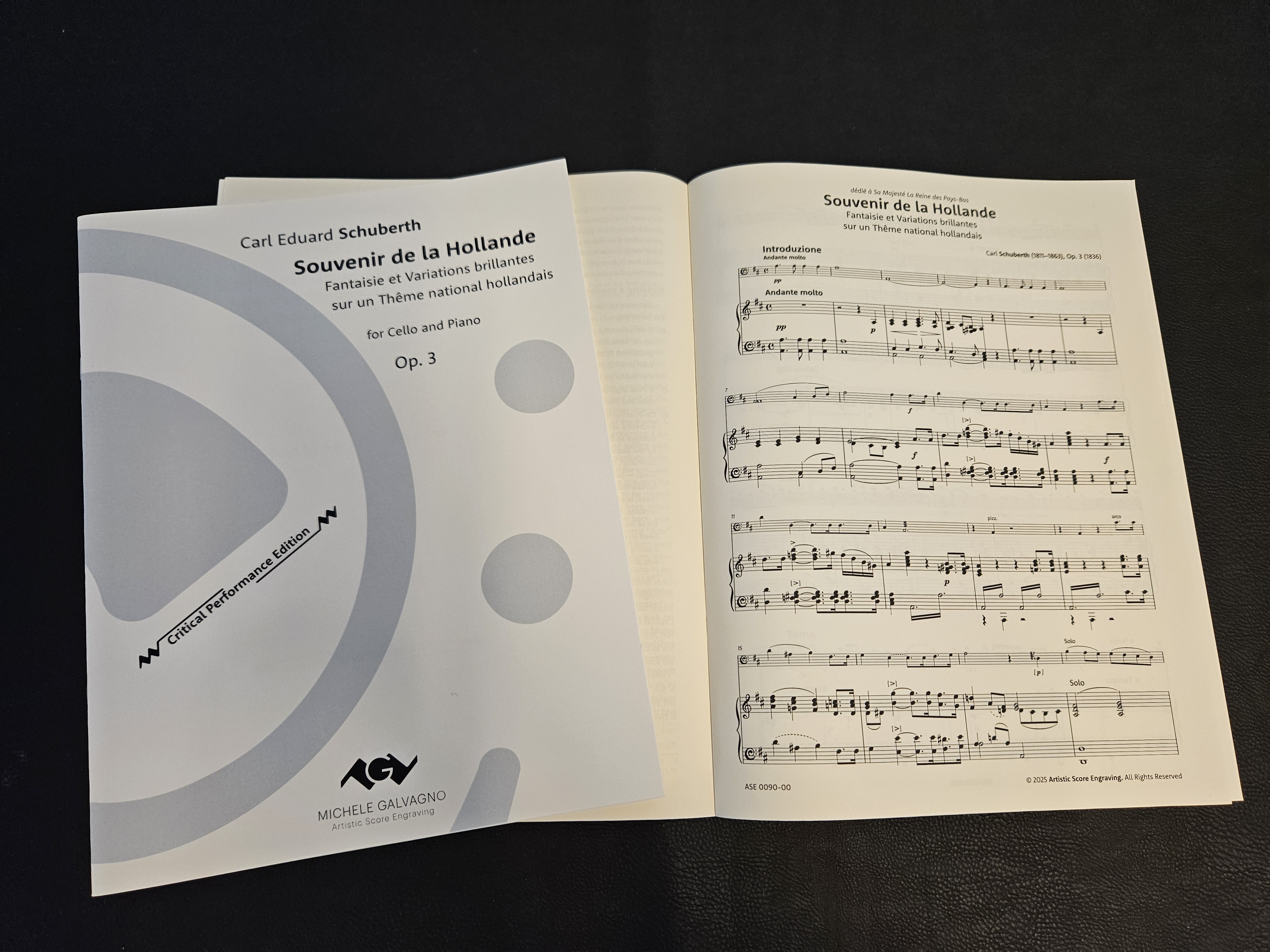
- Carl Eduard Schuberth,Souvenir de la Hollande, Op. 3, now finally available in all its versions:
- Justus Johann Friedrich Dotzauer, Six Exercises, Op. 116, for Cello Solo, co-edited with M° Yuriy Leonovich. It is available digitally here or in printed form here.

- Piotr Ilyich Tchaikovsky, Chanson Triste, Op. 40/2, arranged for Cello and Piano by David Popper. Available digitally and as a physical book.

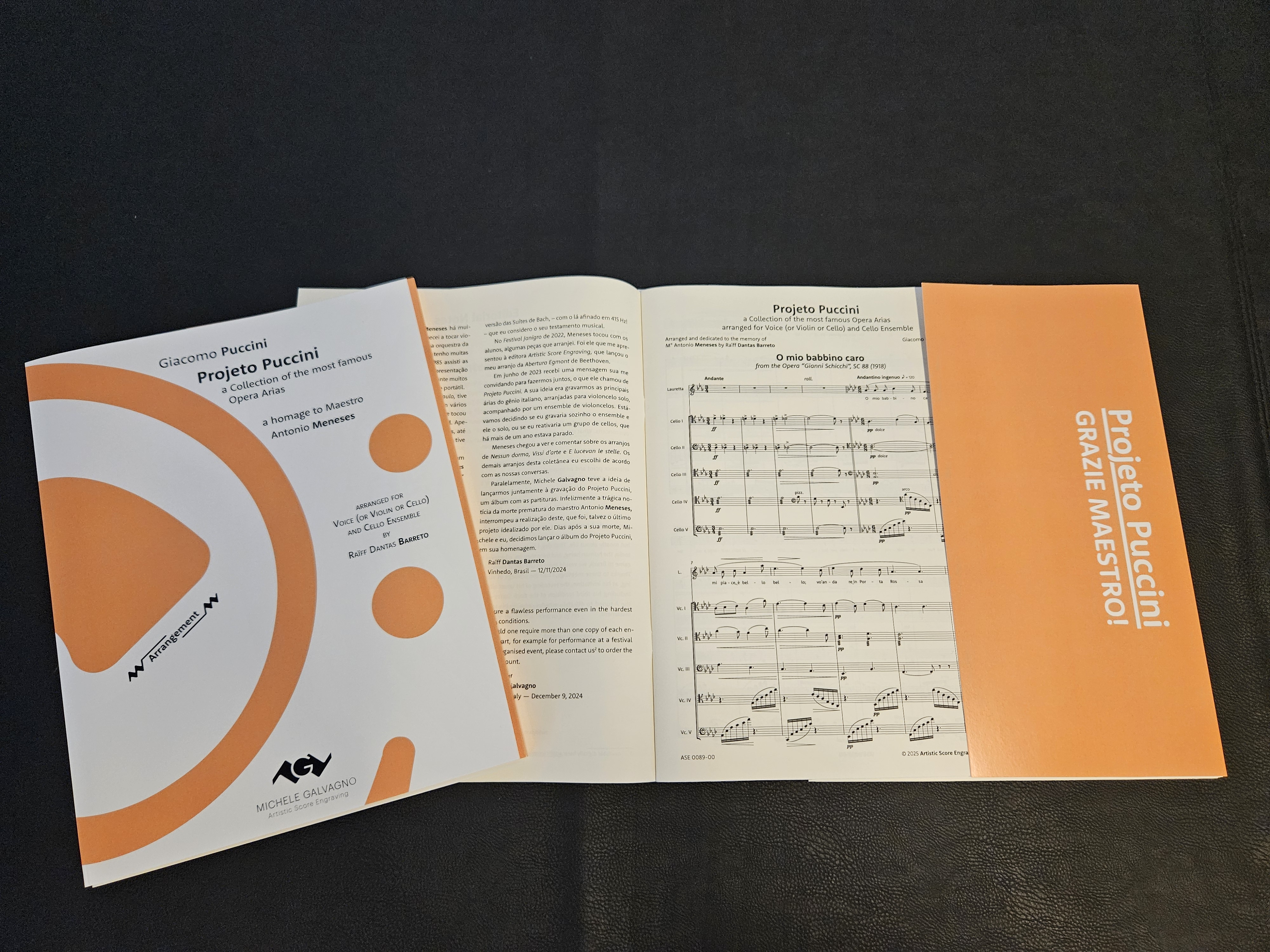
- Giacomo Puccini, Projeto Puccini, a set of seven arias arranged for voice and five cellos by Raïff Dantas Barreto and dedicated to the loving memory of M° Antonio Meneses. Available only as a physical book (single arias are available digitally on all major outlets).
- Finally, Dotzauer’s Trio for Piano, Violin, and Cello, Op. 180, is now available worldwide. It is perhaps the edition I am the most proud of, and I hope some of you will enjoy it. It is available digitally and as a physical book.
From the Cello World …
Back in April I had the privilege of being interviewed by Dr. Benjamin Whitcomb of the University of Wisconsin-Whitewater on his program “You Had Me at Cello”. We chatted for about an hour on my training as a cellist, with special focus on what I learned from M° Carneiro in Switzerland, and on my self-publishing journey. You can find the full interview here.
On a teaching-related note, I have been using the Cello Time first three books as a basis with my youngest students to provide them with funny, short pieces alongside longer, more complex ones. Recently, OUP released the second edition of the second book, with a few concerning changes. Piece No. 7, originally titled “Gypsy Dance”, is now called “Romani Dance”. I wonder if those responsible for this change ever bothered asking those people how they prefer to be called. They may end up being surprised! They also changed (simplified) a bowing, removing the up-bow over the penultimate note of the piece. This was so useful for teaching two consecutive up-bows that I honestly do not understand the change. Needless to say, I have reinstated it on every “second edition” my students purchased this year.
Piece No. 8, then, was, in the first edition, based on the Spiritual song “Pick a bale of cotton”. It was such a beautiful piece, with so much good material to teach! Now, they replaced it with something else, totally anonymous and, in my opinion, not at all on the musical level of the previous piece. I do not understand the reason behind this, but at least some part of it smells of politics, and that is bad because, in the end, students and teachers will suffer.
Closing thoughts
While I have always been fascinated by musical analysis and harmony, and also quite good at it, I recently realised how bad my training in that regard has been. Especially in the recognition and description of the different forms, and of the parts constituting each musical phrase, I feel incredibly weak. I already have almost zero time for anything outside of daily work—which is bad—but I will try to at least read something on a couple of books that were suggested to me.
What’s next?
I am working on a massive personal project (actually three, but never mind), which I hope to release by the end of the summer. There are a few variables about the coming months that worry me considerably, but I am trying to take one step at a time.
Bottom Line
Thank you for reading this up to the end. As always, I value your input, comments, and feedback.
You can join my mailing list to get weekly gifts and promotions; browse my editions; and check what’s available for print in the HNE Store.
My YouTube channel, finally, contains video renditions of most editions.
See you… next time for the ASE update. I hope it will be soon. Please let me know what you are doing and where your musical adventures are bringing you.
Musically yours,
Michele
 Music Preparation Services