
An Artistic Score Engraving update from March 2026
Dear all,
Welcome back to a new instalment of the ASE newsletter. February has been very intense, with plenty of news and events—some positive, others less so—that kept the ball rolling. This month I have plenty of reflections to share with you, and I hope you will get back to me with your opinion and insight.
Should we always understand what we are doing?
I am a control freak, and a paranoid perfectionist—what a start! That certainly ensures a pretty high minimum level of output, but it also makes my everyday life quite hectic. I would not say ‘stressful’ because I generally love what I’m doing, but I feel that I often overthink problems instead of just trying to do something and see what that brings.
In early January I began the engraving of a most complex piece, one where every single bar had something unusual, non-standard, or plain mysterious. My general approach had always been to understand what the notation was trying to communicate before deciding what to do to best replicate it. When time is short, though, that approach can prove fatal. Additionally, in the past six months, I have received more than one remark about my habit of asking too many questions or leaving too many comments when working on a score. While most of them are eventually appreciated because they help the editors see things they may have otherwise overlooked, their sheer quantity has frequently been deemed too great.
My wrong assumption, then, was that this kind of discipline was not only necessary, but common to the industry. While I will keep littering my scores with comments because that’s the only way I can remember about things while working on multiple projects, I will strongly filter down those that I eventually share with the editors. In the end, the advantages for me—keeping 100% track of things—will remain, and the burden for those I work for will be greatly diminished.
Going back to the complex piece of two paragraphs ago, I realised that, if I wanted to have even a slight change of completing it in time, I had to just do it! And so I did, actually enjoying the process much more than I had expected!
Lesson learned: if you feel blocked by something you do not understand, just do something or, fine, actively decide not to do anything, just do not sit still in doubt.
My enthusiasm, your enthusiasm, our … ?
There’s a double-edged sword in my general attitude towards things: I am an incurable enthusiast! I pour all myself into things, investing most of my physical and mental energies to get the best result possible. This has its advantages, but it is certain to work only when you are alone doing something. As soon as you collaborate with other people, striking a balance will become extremely difficult, and a gap will inevitably form between each other’s expectations. Something I am therefore trying to learn is to keep my enthusiasm alive while expecting nothing from people around me. The disappointment I have felt over the years for realising that certain people collaborating with me on specific projects were not sharing my same enthusiasm was just too painful to endure. As soon as I would realise that, I would turn into a bitter and resentment-driven version of myself, which is never a good thing. Sporadically, this would make others realise that they had gone too far in ‘(ab)using’ my enthusiasm to drive a project forward, but those have been rare moments.
A general shroud of sadness has since fallen over me because I have realised that, in business, one needs to forgo all emotions and become a mindless, emotionless machine. Not because one needs no passion for what they are doing, but because all those emotions, blended with deadlines, financial reports, budgets, etc., can (and will) kill you—mentally, at least.
Recently, then, I was given a task with a specific deadline; as always, I have complied but, when I communicated my readiness to deliver, only silence came. Finally, it took almost two months over the original deadline to get this project into port, with immense frustration on my end.
Lesson learned: invest only the energies you are willing to sacrifice for no guaranteed return. If someone tells you something is time-critical, say yes, then wait for them to contact you again, proceeding at your usual pace. If it is truly urgent, they will. If it is not, you will not have wasted your health.
There’s always a first time!
For fifteen years I have been engraving professionally for composers, arrangers, and publishers around the world. For fifteen years, not even once I have missed my deadlines. Something new happened in the past two months, though: I was removed from a project that had been assigned to me almost half-a-year ago, and all that before we could even begin with it. I had reserved the time, moved other commissions around, warned other customers about being very busy up to Spring 2026. Then, all vanished, with motivations that were a bit clutching at straws.
Lesson learned: do not count your chickens before they’re hatched or, as we say in Italian, ‘don’t say cat until you have it in the sack’.
A helping (artificial) hand!
On the positive side, I have to say that I have learned a lot about interpreting corporate emails and replying to them in the proper way thanks to AI. I am not asking AI to rewrite my emails for me—because that invariably makes them sound like machine talk—but rather to explain to me what those words mean in a specific context, and how the recipient could read and react to my words.
One needs to always proceed with care, though, because, at least according to how AI agents are currently programmed, they have the slight tendency to massage your vanity. If you do not realise that in time, you will be in serious trouble. AI is a tool, and as with any tool, you are responsible for how you use it and for what you use it for.
NEW EDITION!
I would have many other things to say, but I am approaching my reading time limit, so those will have to wait for the next instalment. I want to conclude this update with—finally—the announcement of a new edition. Four months without new editions are much more than I could have ever imagined, and it is only now clear how much the switch from a third-party distributor to complete self-management disrupted my workflow. I learned immensely from that, though:
- storage, dust/humidity-protection, and classification;
- packaging, padding, shipping, tracking;
- planning restocks and new prints;
Someone could have thought I would have just crumbled over the weight of all this. Instead, I thrived and, through hardship and bloody sweat, became stronger. I now have a personal relationship with all those who purchase my scores, and can react quicker than anyone else because I am literally five metres away from the books!
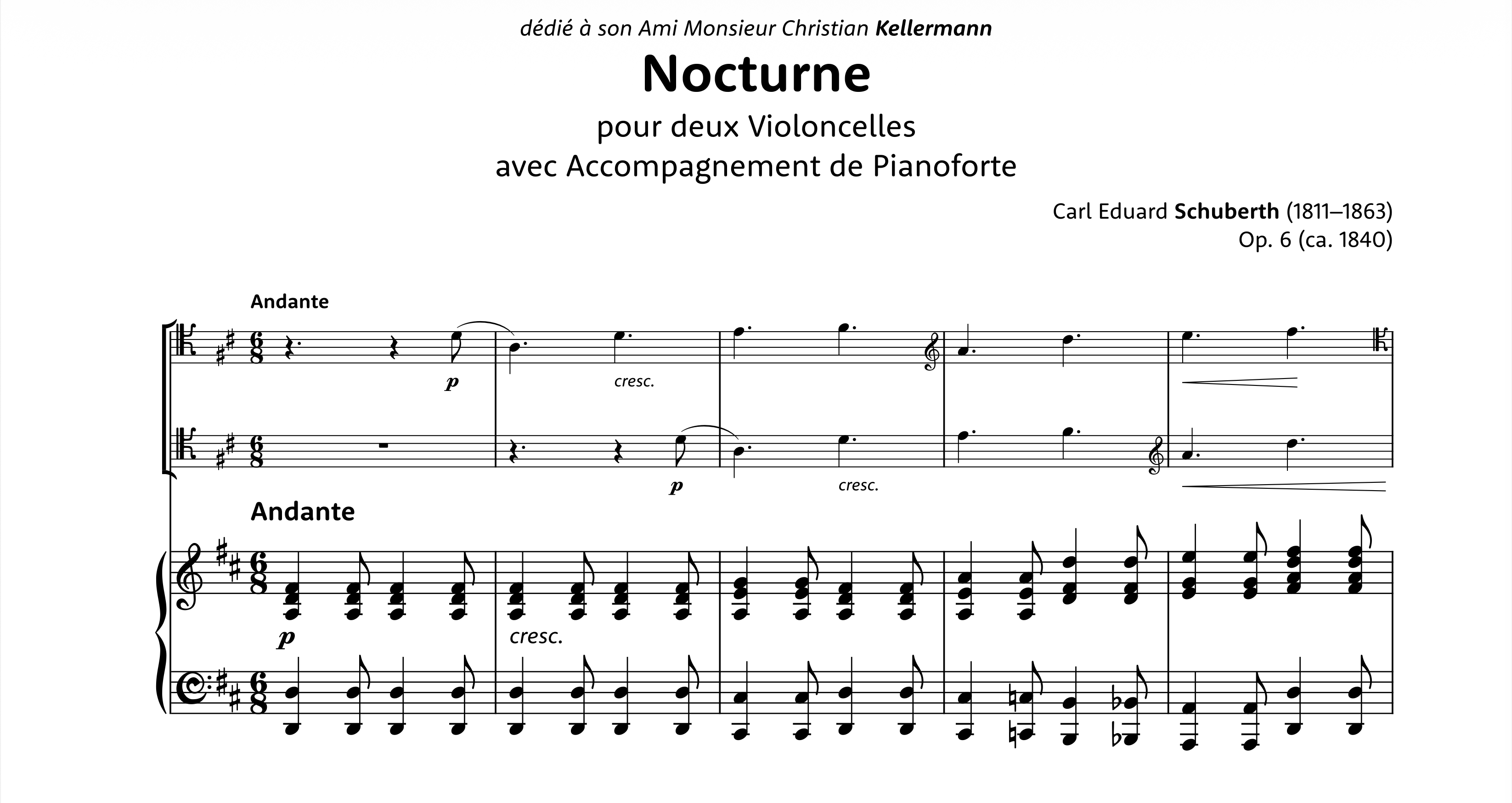
The new edition is the Nocturne for two cellos and piano, Op. 6, by Carl Eduard Schuberth, in its 1840 version. You can read the full editorial notes here. The edition is available digitally here and here, while a promotional video can be watched here. The printed version will be available by the end of March / beginning of April.
Bottom Line
That’s it for today! Thank you for reading this up to the end.
You can join my mailing list to get weekly gifts and promotions; browse my editions and contact me directly for printed titles. My YouTube channel, finally, contains video renditions of most editions.
See you next month for the next ASE update. Please let me know what you are doing and where your musical adventures are bringing you.
Yours,
Michele
 Music Preparation Services
What you describe is indeed a real problem. However, I believe that this type of work genuinely requires meticulous attention to detail and a systematic way of thinking. What has been on my mind lately is how to explain to a composer—whose piece I am engraving—that the way the music has been notated in the manuscript is quite far from standard notation practice. At the same time, of course, the composer is the one paying for the work, and I will ultimately produce what I am being paid to produce—even though I know that, from a professional engraving perspective, it is not really correct… and frankly, it often does not look good either. So the question that concerns me is: where is the line? At what point should I say that I cannot engrave something in a certain way because it would harm my professional judgement and my credibility as an engraver?
Gabor
LikeLiked by 1 person
Thank you for sharing your experience!
I believe that one should politely point out how things should be expressed on the score.
If, after that, the customer/composer/publisher insists, then one just complies or, as a great composer once told me, “agrees to disagree!”
Best of luck!
Michele
LikeLike