
An Artistic Score Engraving update from June 2026
Dear all,
Welcome back to a new instalment of the ASE newsletter. If April had been a truly tough month, May showed me how hard it is to recover when you have touched the bottom. While the respiratory issue stabilised, I still felt fragile and vulnerable. From one side I would have liked to share everything that happened in full detail but, after careful consideration, I decided to opt for a summarised version of what I believe brought me to this point.
The end-boss!
The first third of 2026 was characterised by a major actor in the music industry that—somehow—I had luckily managed to dodge until now: the dreadful serial procrastinator! This mythological creature is usually a composer who—in the best of scenarios—likes to revise things way beyond the deadlines. As a consequence, the copyist will need to work around the clock to manage the delivery. Often, this also involves a publisher in the middle who will eagerly sacrifice the copyist without shedding a single tear1, given that such composers are those bringing the big sponsors in.
When such a scenario presents itself, a copyist has two options: negotiate better tariffs for the urgency or accept the worse working conditions. The first option, then, can have two most-likely outcomes: the publisher refuses the raise and looks for someone else or, more rarely, they accept and start dehumanising you as only your worst dreams could fathom. The second option, instead, will have serious consequences for the copyist’s health but, at the same time, be superb for their psyche because the publisher will cover them in blarneying proportional to the money that was saved.
Any music copyist that has been long enough in the industry will know this to be true and, in the first four months of April 2026, I experienced all of these options and variants in a machine-gun-like sequence! This prompted some serious reflection on the nature of our job and on where the industry is heading—or, perhaps, where it has always been without me noticing?—:
- Deadlines will get ever tighter because no one will hesitate to drain a professional individual until they are little more than a smoking, empty husk.
- Money is becoming less of a problem for big customers: as long as you are ready to work under inhumane conditions, you will get offered more than usual. The issue with this is that: you will never get to even think about how to spend your hard-earned reward!
Having experienced all that—from being dumped for asking more after a composer got two months late on schedule to being paid 50% more than the base tariffs for working day, night, weekends, and holidays2—, I have realised that this way of working managed to achieve what I honestly thought was impossible: they got me to hate my job!
This will have serious repercussions for me in the coming months as, first, I truly need some rest and, second, since I do not see any space for that in sight, I need to find some ways to build up an effective resistance strategy. Last month I shared with you the Pomodoro technique and my Tai Chi practicing, but that is far from enough. I require something more and, for now, I have got no smart ideas. If you ever found yourself in a similar situation, please get in touch, I would love to hear from you about your experience.
A short reflection on freelancing
Over fifteen years of practice, and especially in the first years, I have had several ‘experiences’ where the customer would just run away with the job without paying. Living in Italy, it is quite common (if not the norm) to do something and then to have to run after people for money, regardless of the sector. This was what I and all my fellow music students performing gigs or our first professional concerts were used to: you play, then you wait, sometimes for months. When the first couple of such occurrences happened to me in the engraving world, I sought advice from colleagues. Besides being laughed at for my being naive, I learned that—at least in more business-savvy countries:
- You ask for half deposit in advance
- You deliver watermarked files (!)
- You get the remaining balance
- You deliver clean files
They also stressed how every job should be regulated from a written agreement, and I can let you imagine how people here in Italy reacted to that. People here do not like anything being written down because, then, they cannot change their mind or tell you that you didn’t understand each other.
Recently, when I asked for written warranties that I would be paid for a massive job, I was met with scorn and disdain:
Don’t you know who you are working for? We’ve been in business for two hundred years, and you are afraid of not being paid?
To the first question: and so? Who cares? Do you want me to recognise your prestige? Hire me in a top editor position, with all the consequences employment brings: a stable wage, end-of-the-year bonuses, paid holidays, paid healthcare, fixed working hours, weekends, no emails/phone calls after 6 PM! Then, and only then, I will trust you on this! Or, alternatively, build a payment history I can rely upon (especially, do not even propose to pay in 30 days or more!).
To the second question: this is a clear deflection attempt, trying to move the focus away from them. Whoever you are, you could go bankrupt next month for what I know, or be already drowning in debts so that I will never be able to recover what you owe me.
I am perfectly aware this all sounds “oh so harsh”, and that one needs to trust someone. Of course, I trust people when I can talk to them and perceive their character and intentions from their words and tone. I just will not trust entities that can disappear behind endless layers of bureaucracy.
So, in the end, if you are a freelancer, remember this: you do not work for someone, you collaborate with someone. It is a clear difference, and we should not forget that.
NEW EDITION!
A new, shiny edition joined the family during May, and it is the second instalment of the complete republishing project around Dotzauer’s Violoncello School, Op. 65 (1824). This volume extracts the twenty-four two-octave scales from its Appendix 1, places them one after the other in an easily accessible format, and adds thirty-five melodic and rhythmic practicing ideas to be applied to each scale. This is a minor sister edition to the already available “Scales & Exercises from Appendix 1” published last year (available digitally here and printed on demand). It does not contain any duet, but adds practicing patterns in their stead.
The digital version of this title is available here. The printed copy is already available, just contact me to get it.
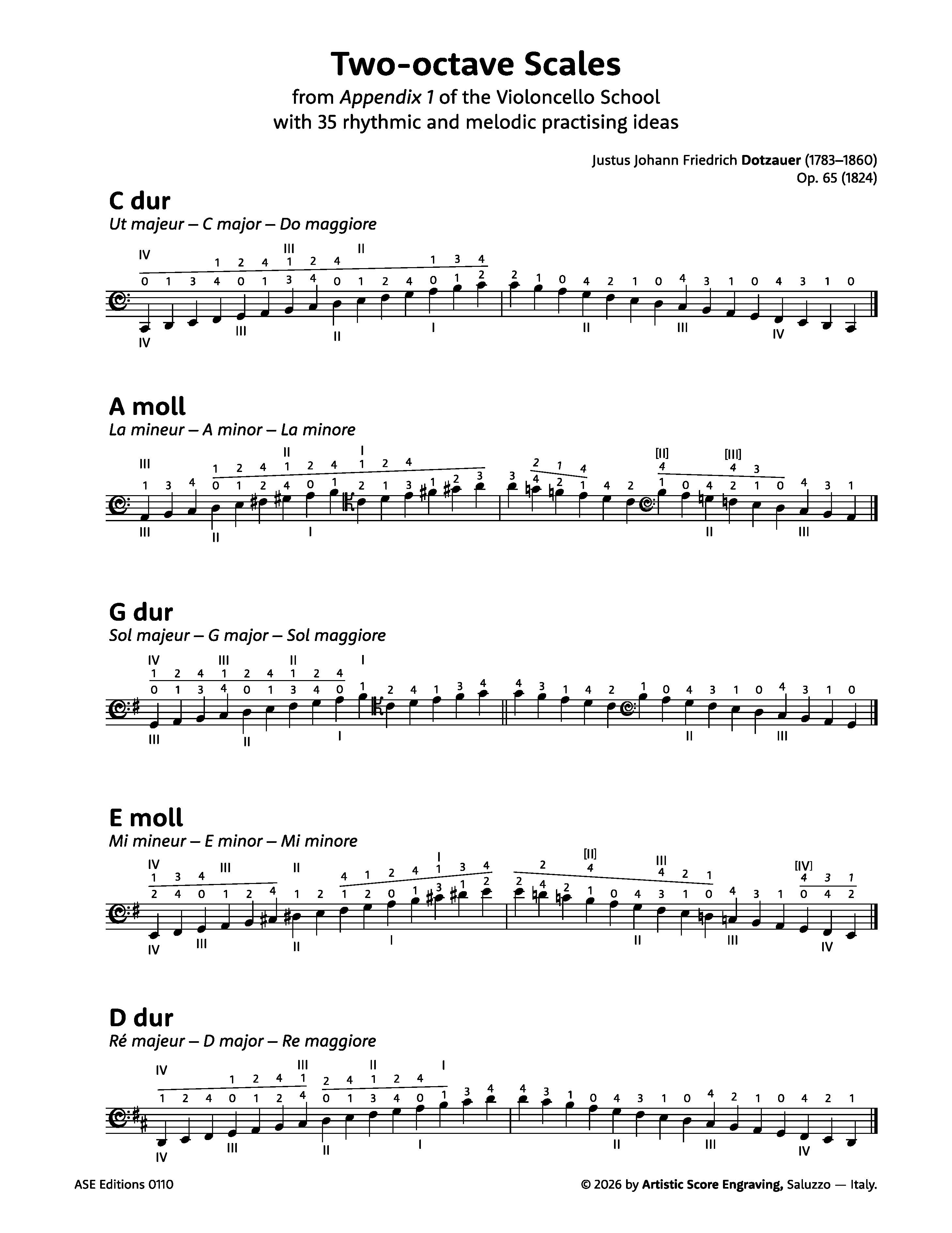
The third book is in preparation and will be printed in late Summer / early Fall, followed by the final textbook at the onset of 2027. You can also expect a premium boxed set including all volumes. Stay tuned for that!
At the same time, the physical copies of ASE 0112 (Piatti – Twelve Caprices with Piano, VOL. 1), ASE 0113 (Schuberth – Nocturne Op 6 (1840) for Two Cellos and Piano), and ASE 0114 (Prokofiev – Flute Sonata Op 94 arranged for Flute and String Quartet by Lee Bradshaw) are immediately available. All these titles are also available for streaming on nkoda and MuseScore (if you have the subscription).
Bottom Line
That’s it for today! Thank you for reading this up to the end and, please, share with me what you think, especially about how you manage the financial side of your freelancing. I read everything and try my best to reply as swiftly as I can.
You can join my mailing list to get weekly gifts and promotions; browse my editions and contact me directly for printed titles. My YouTube channel, finally, contains video renditions of most editions.
See you next month for the next ASE update. Please let me know what you are doing and where your musical adventures are bringing you.
Yours,
Michele

