
Announcing the publication of the Six Pieces for Three Cellos, Op. 104
This article constitutes the second part of an expanded version of the Editorial Notes that can be found in the published edition, available as a printed book (on demand) as well as digitally (PayPal/Stripe — Apple Pay/Credit card). A promotional video of this edition can be watched here.
EDITORIAL NOTES — PART 2
Analysis of the pieces — Part 2
No. 1
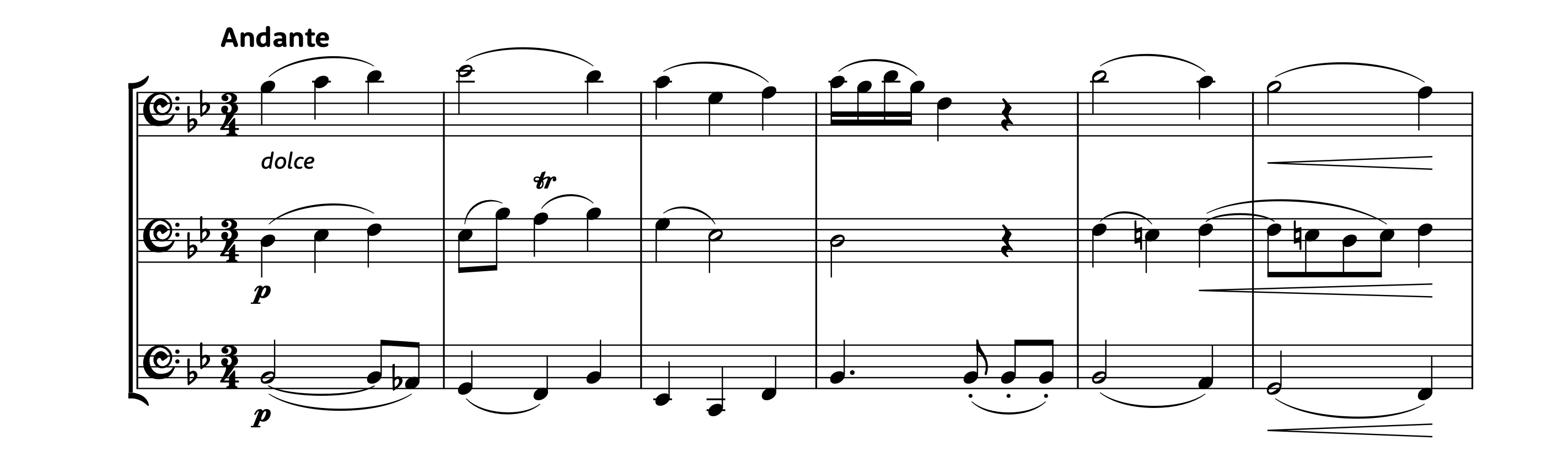
A profoundly lyrical piece opens the collection, with the first two cellos singing in ascending sixths and the third descending in contrary motion. Marked as an Andante and set in Bb major with a 3/4 time signature, this piece has a simple ternary form. Part A (bb 1–16) explores the home key and its Dominant (F major), while Part B (bb 17–44) wanders around G minor, using several chromatic lines to touch neighbouring keys with an apparently untroubled attitude. Part A then returns unaltered (bb 45–60) to bring the first piece to a close.
The writing is deeply contrapuntal, with the first cello conducting the musical discourse most of the time. The range is often narrow and rarely exceeds two octaves between the top and bottom notes, resulting in a generally sombre character. The fact that the highest position required by any voice is the fourth one makes this piece an ideal proposition for young intermediate students.
No. 2
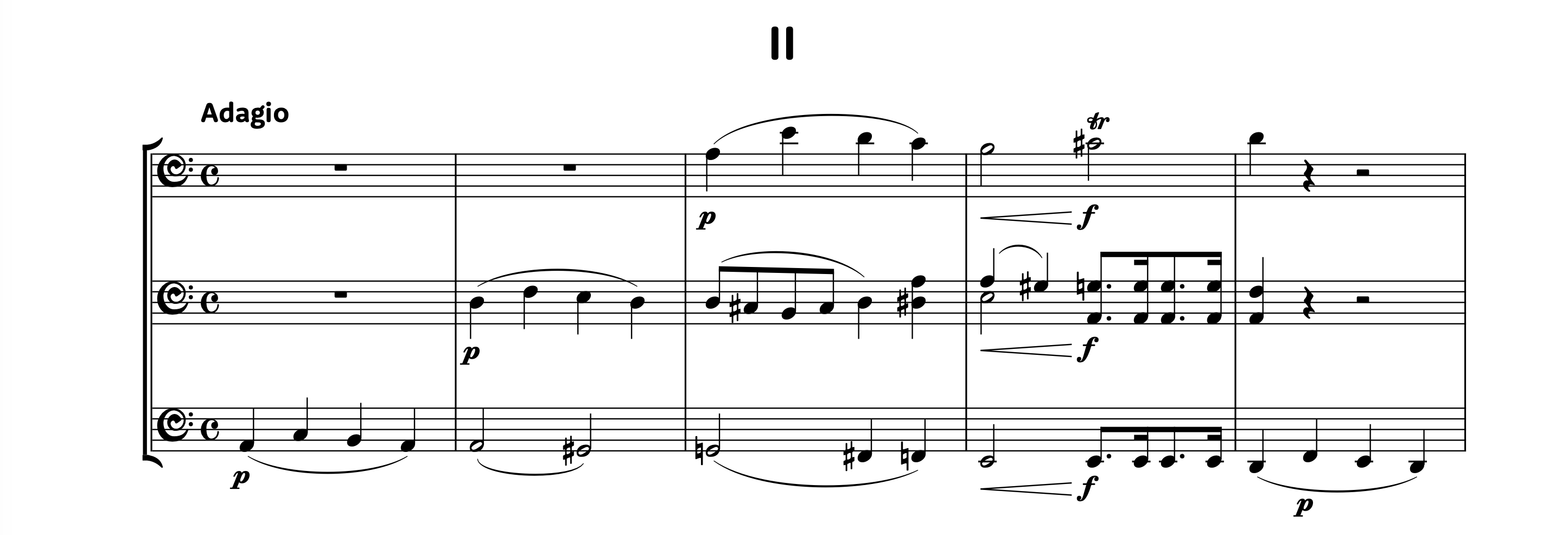
The second piece (Adagio, A minor, C, 22 bars — Allegro, A major, 6/8, 222 bars) begins with an imitative prelude where the harmony builds up from the third cello, its line descending into the darkest abyss of the cello register and creating a blossoming contrast with the rising melody of the first cello. The tonal journey chosen by Dotzauer passes through D minor, F major, G minor, and C major, before rounding back to A minor through intense chromaticism. The first section ends with a long dominant pedal and a half cadence, lightly decorated by the first cello.
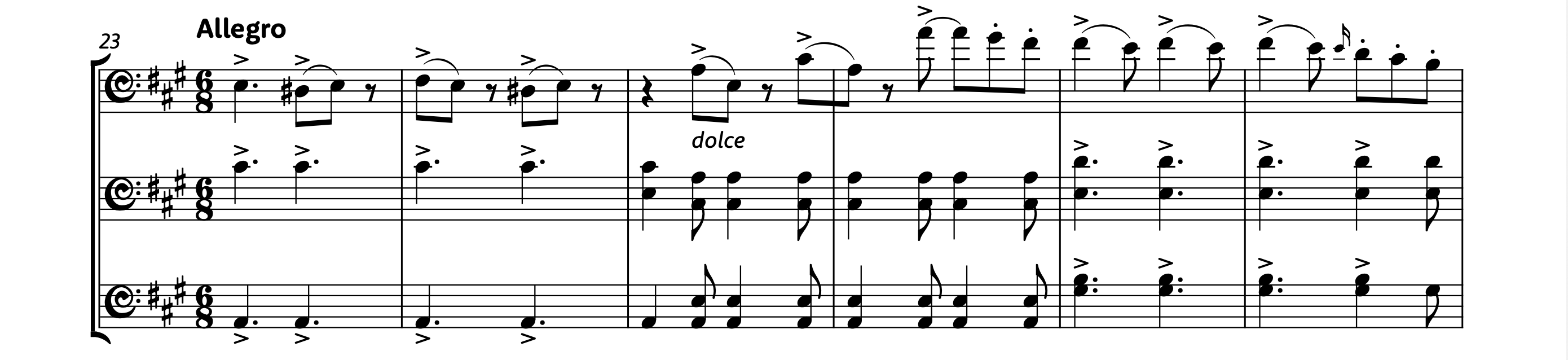
The second macro-part of the piece is an enriched transcription, in rondo form and arranged for three cellos, of the ‘Ballet and Chorus’, No. 21 from Act III of Carl Maria von Weber’s opera Oberon. The first 76 bars (Part A) are an exact match, while the key signature change to F major in b 82 allows Dotzauer to bypass Huon’s initial entrance and to continue elaborating on the orchestral accompaniment. What follows (Part B, bb 96–141) is a virtuosic episode based on scale fragments, where each instrument passes the baton to the next one in an apparently endless circle. Part A makes a return in D major (bb 142–157), with a shortened version of Part B immediately ensuing (bb 158–165). This bridges the gap to A major through a short return of the main theme in E major, although its melodic structure is considerably reduced, almost as if a music box were slowly winding down. The key signature then returns to A major, marking the return of the first part on stage, with a fanfare-like final period in ff dynamics that almost sounds like a joke after all that was heard before. The last A major section (bb 178–244) is, once again, a faithful transcription of the orchestral score.
No. 3
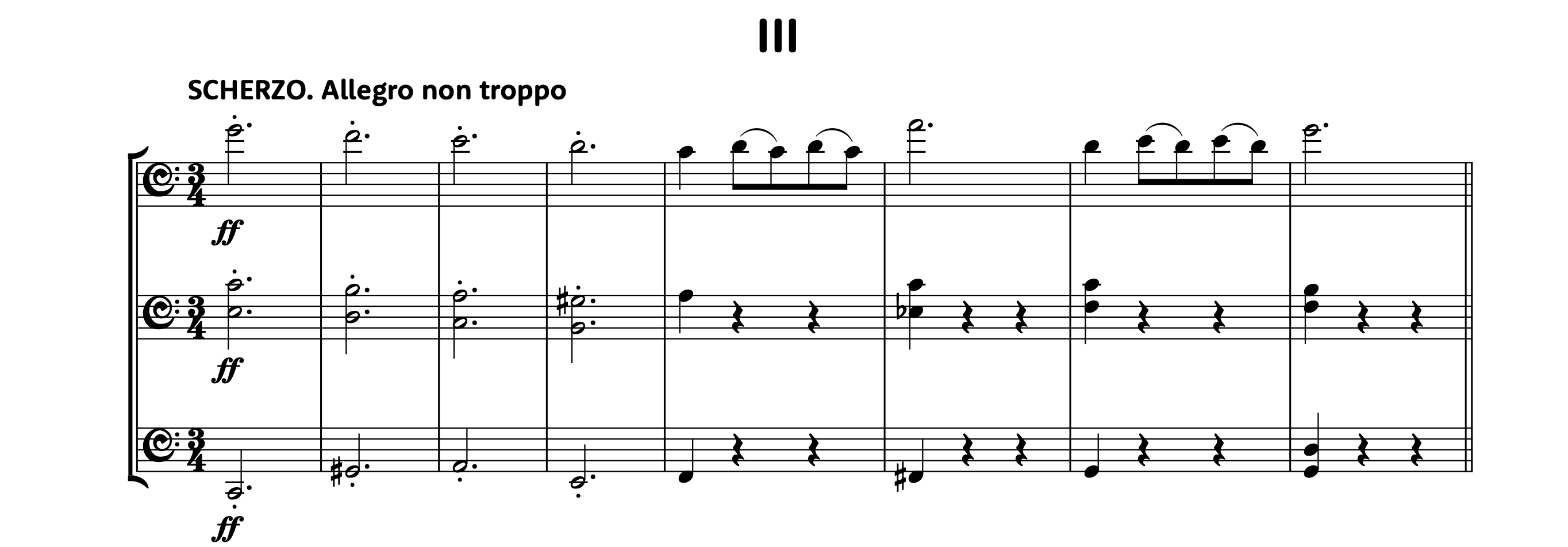
The third piece, in compound ternary form, begins with a Scherzo in C major (3/4, 96 bars). A brief introductory period gives way to the main melodic idea with the musical energy directed towards the downbeat of the second bar, open-string pizzicatos helping to maintain the pulse. A short bridge ensues, driven by a single ascending scale and by several tentative descending fragments, the last of which introduces the key of G major. Arpeggios across three strings in the third cello part accompany a simple canon at the unison with a two-bar delay, with the added feature that the whole passage is played in natural harmonics. After the repeat, Part B begins in A minor, developing a melodic idea first heard in the introduction. The arpeggios wind their way through the three cellos, trying to catch the elusive theme until, suddenly, all three converge to recall the main theme, this time in Eb major (b 45). Shortly after, they decide to engage in a chromatic descent followed by a new exposition of the secondary theme in the new key, this time no longer accompanied by arpeggios but instead by a new contrapuntal line. An Italian augmented sixth chord (b 64) introduces a dominant pedal section that brings back the main theme in the home key of C major (b 73). The Scherzo comes to a close with the return of the natural-harmonics canon, this time in C major.
The Trio (F major, 3/4, 79 bars) begins with a three-bar introduction that proved quite difficult to decipher from the sources. The first cello had three bars of rest before the start-repeat sign and no alternative ending in the first part, while the second and third cellos had a two-bar start and a full-bar rest at the end of Part C. The second large-scale section (Part D) would otherwise not align properly between the three parts. A careful aural and harmonic analysis made it possible to rebuild the score in modern notation. It should be recognised, however, that the solution adopted by the sources—assuming one does not need a full score—is the most efficient for both performing and printing. The Trio is of a pastoral character, with one cello singing the secondary theme of the Scherzo, and the other two accompanying it with columns of chords. It has an almost duet‑like character because, whatever the melody is doing, the two lines below move in the same rhythm. Part D opens in the same way as the beginning did, just this time in D minor, the secondary lines gradually separating and thus expanding the orchestration. A modulatory bridge in the lower regions of the third cello (bb 45–52) leads back to F major for the return of the main theme. The Scherzo should then be played again, presumably without repeats, even though Dotzauer does not specify this explicitly.
No. 4
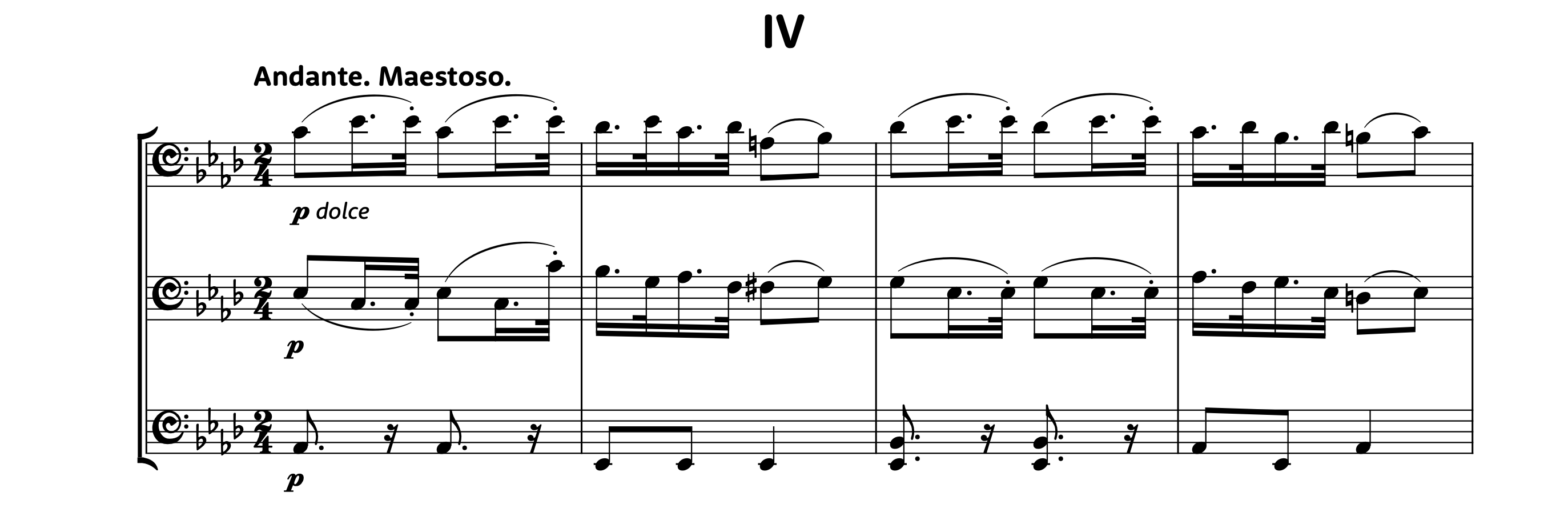
The fourth piece (Andante maestoso., Ab major / F minor, 2/4, 40 bars) is another compound ternary form, and is quite short but, at the same time, rather intense. There is no real time to develop any melodic idea, both Parts A and B being each eight bars long. The first two cellos sing in thirds and sixths over the same rhythm for four bars, the third cello supporting them with a dignified bass line. The following four bars that lead to the repeat see the first cello pursuing its soloist role, while the other two alternate chordal and contrapuntal accompaniment. Part B opens with the awareness that, from C major, a path back to Ab major must be found. A chromatic ascending line in the bass makes this possible through Db major, then Eb major, F minor, G minor, and, finally, Ab major. The opening ‘theme’ returns, the continuous excursions into neighbouring keys blurring the tonal boundaries and favouring the transition to the next section.
Even without a proper title, this new section is the most interesting of the entire piece. There is a pizzicato line passing through the different cellos—third, then second, finally first—, the other two engaging in an imitative duel over the main rhythmical idea. After the initial period, Dotzauer feels the need to change the key signature to A minor, having ventured too far from the initial key. Four bars revolving around E major chords (Dominant of A minor) give way, through a sudden shift, to four bars of C major, preparing the return to F minor. The next—and final—eight bars are almost the same as the first eight, with the last bar omitting the D natural to allow the leap back to the Andante.
The contrapuntal intensity and textural density of this piece are impressive, with a Romantic harmonic language that, coupled with its late-Baroque and early-Classical form, makes it an ideal case study for composition and analysis classes.
No. 5
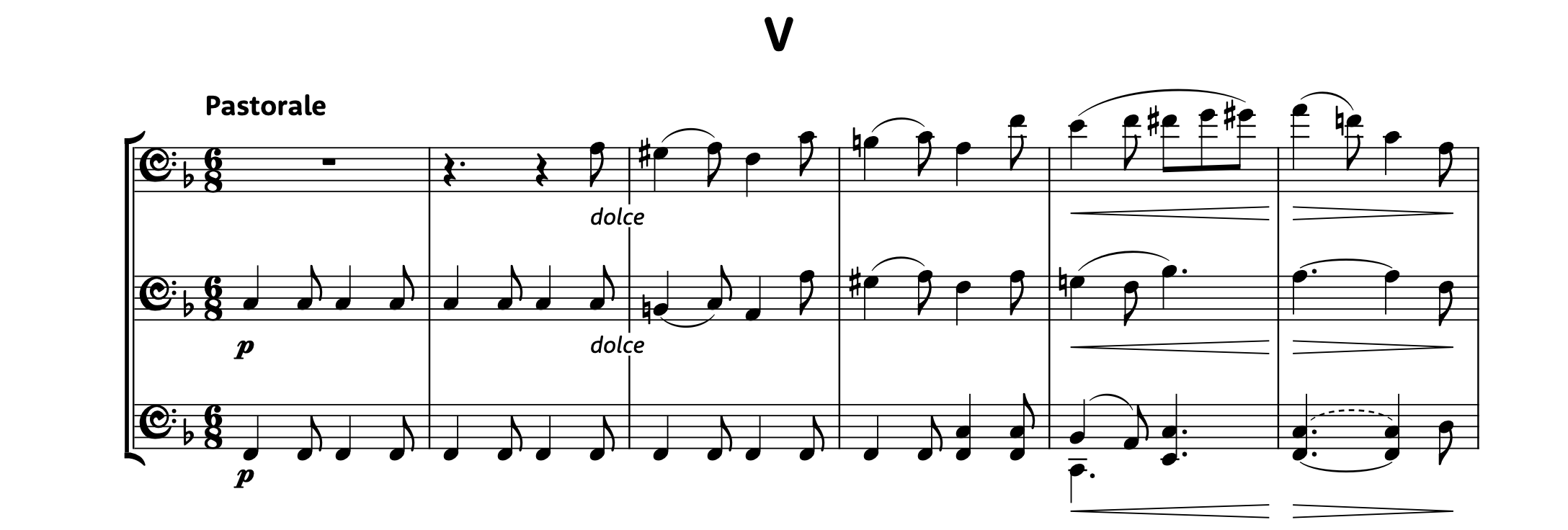
The fifth piece (Pastorale, F major, 6/8, 60 bars) is, once again, in compound ternary form, this time, however, with no repeated sections. Its Pastorale marking, coupled with the F major key, clearly alludes to other celebrated works of a similar idyllic character. The supporting rhythmic foundation is provided by the third cello part, while the two upper voices sing in parallel sixths and thirds. The alternation of larger intervals with minor seconds gives the opening melody the feeling of a village festival, as if the community had gathered to share and enjoy a summer evening together. The second period (bb 10–17), firmly built upon a dominant pedal (C), has the first cello introduce a dance-like, reverential motif, slightly reminiscent of the chorus in the Finale of Oberon. A tragic, and yet deeply expressive, diminished seventh ascending leap, followed by a chromatic descent paves the way for the return of the opening theme. The closing exposition explores two neighbouring keys (Bb major and G minor) before allowing the second cello to use the secondary theme in the home key of F major to bring this first part to a close.
The second part, in D minor, opens with a tragic ascending melody in the first cello, accompanied by wave-like lines that allow the more positive F major to come back. It would not be a piece by Dotzauer if a canonic fragment did not manage to sneak its way through (bb 38–41). The drama of the initial melody and the heroic opposition of the canon alternate two more times before settling on an F major dominant pedal. The resolution, however, is in the minor mode, with diminished sevenths further intensifying the theatrical atmosphere. This whole part, in fact, could only end on a half cadence, necessitating a complete return to the beginning of the Pastorale.
No. 6
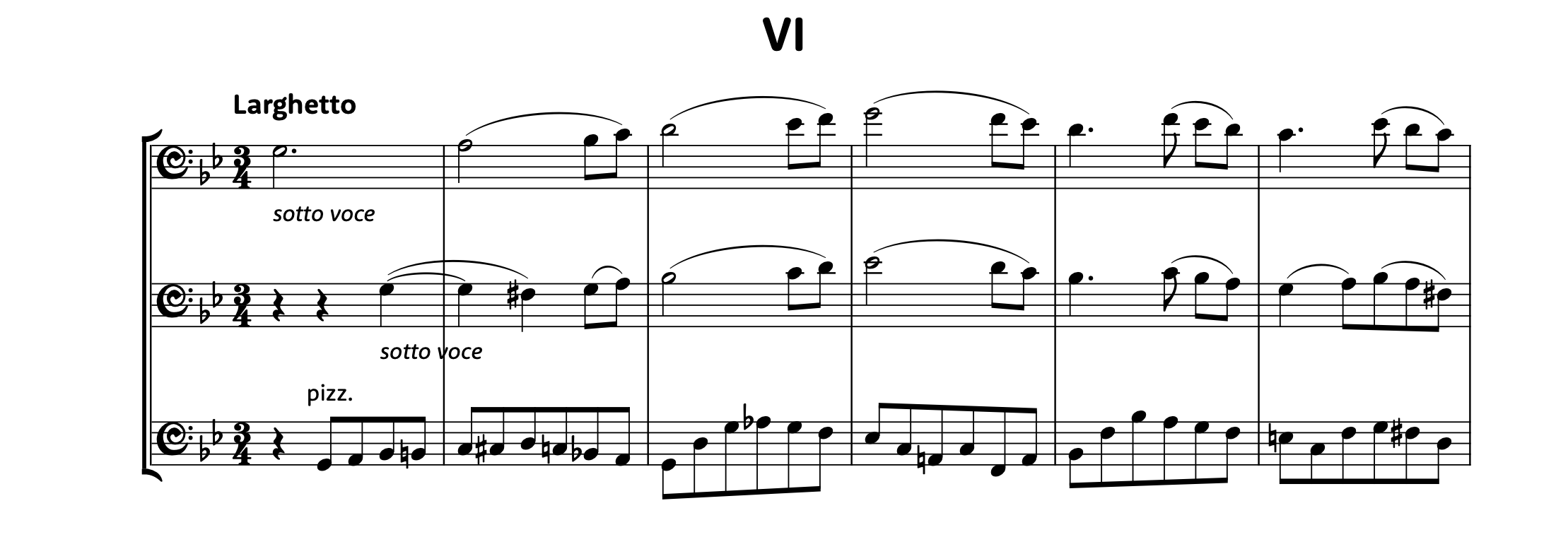
The sixth and final piece of the collection is also the longest one. It is divided into two parts: a Larghetto (G minor, 3/4, 54 bars) and an Allegro (G major, 2/4, 244 bars). The first part—itself loosely divided into three smaller parts—opens with the first cello singing an arching melody spanning eight bars, accompanied by a countermelody in the second cello and a regular pizzicato line in the third voice. The first two cellos are marked sotto voce (quietly, under one’s breath), while the third cello will remain in pizzicato up to b 25. A short exploration of F minor and Bb major then favours the subsequent landing in Eb major, thereby introducing Part B. The leading melody here is almost entirely built upon chromatic lines split between the first two cellos, the third one engaging in a stoic attempt at bringing order to the maelstrom of shifting keys. The third cello eventually abandons its pizzicato (b 29), trying instead to develop the initial melody with a contrary-motion line in C minor. The first cello now answers with a syncopated appoggiatura, forcing the lower voice to veer away in imitation. This continued melodic quarrel risks compromising the stability of the entire edifice, obliging the second cello to take the helm and restore the pizzicato. Light suddenly breaks through with a rapid, ascending shift to F major, but it is not to last, as a rogue F# passes through the three voices until the initial G minor is restored. The opening melody returns, but the third cello has not consented to resume its pizzicato role, forcing the second cello to maintain it until the end.
The half cadence of bb 53–4 leads to the second chapter of the piece, the Allegro in G major in rondo form.
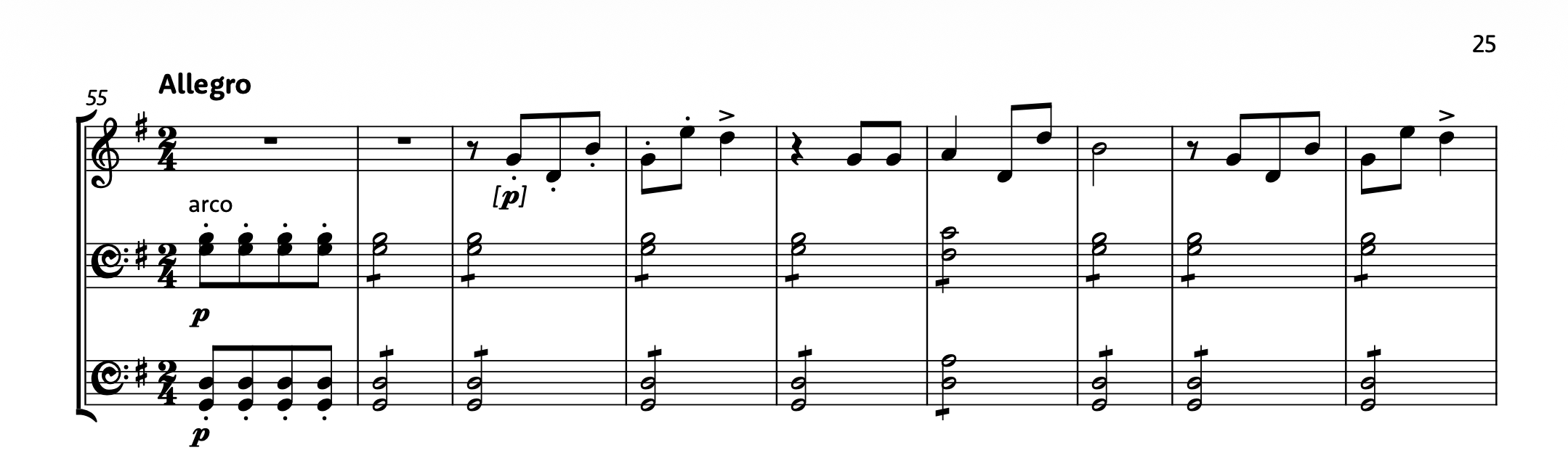
The melody is once again drawn from Carl Maria von Weber’s Oberon, this time No. 16 from Act III of the opera. The third act had just opened with Fatima (Rezia’s handmaiden) remembering her homeland (‘O Araby! Dear Araby! My own, my native land!’) in a slow, poignant aria. The Allegro (A) then suddenly erupts (‘Al, al, al, al, al, al! Though the night star be high’). Up to b 108, the reins remain firmly in the first cello’s hands since this is a faithful reproduction of the operatic score. Anything that follows, instead, is Dotzauer’s own development, touching Bb major (b 117) and D major (b 129) before a virtuosic episode (B) ensues (bb 141–156), based on the ornamented scale fragments of bb 104–105 and firmly grounded on G major’s dominant pedal (D). Part A briefly comes back (bb 157–165), this time splitting the melody between two instruments. A deceptive cadence (b 166) suddenly shifts the tonal centre to Eb major, giving the melody to the third cello in the low register and affording the second cello a brief—and rare—moment of respite—a rarity, given that rests are an extremely rare occurrence in this collection. A new modulating bridge uses the theme in Eb minor to turn a Cb into a B natural, paving the way for a virtuosic episode (Part C) in C major (bb 190–241). The ornamented scale fragments are, this time, staggered in consecutive entrances, a descending countermelody in contrary motion lending them even greater effectiveness. With remarkable ease, Dotzauer drives the harmonic discourse through F major and D minor, before a chromatic descent in the three voices veers towards C minor, Bb major, and, finally, G minor. The final period of this long episode eventually arrives in D major, heralding the return of Part A in its home key of G major. An almost snare-drum-like accompaniment (bb 230–240) then welcomes the original theme, this time with an entirely new contour. The second cello engages in an arpeggiated sequence on the first two strings, continuously alternating between tonic and dominant harmony. At the same time, the third cello buoyantly observes from afar with detached pizzicatos. The second period of this last part (bb 253–263) shifts to A minor, paving the way for the closing page of the score, where G major returns definitively in b 264. The first cello is now on full display with arpeggios over three strings, while the two others engage in a contrapuntal dialogue over the opening fragment. The final bars of the piece—and of the entire collection—allow the trio to don their best brass-band attire, bestowing an epic and heroic closure.
About this edition
While this edition is based on the two surviving original sources from 1828 and 1835, it contains all necessary corrections to bring its notation up to modern standards. Whenever the notation deviated significantly from the original, it has been marked in the Critical Notes section at the end of the volume.1 The edition comprises a book containing the present Editorial Notes, the full score, and the Critical Notes and Performance Notes at the end. The three cello parts are offered in two versions: one showing the original fingering, bowing, articulation, and dynamic recommendations by Dotzauer himself, and one containing performance suggestions by the cellists who gave the première of this edition in Dresden at the Dresdner Musikfestspiele 2026 (‘Dotzauer Abend’ — 13 June 2026): Norbert Anger, Sebastian Fritsch, and Friedrich Thiele.
Acknowledgements
My deepest thanks go to the City of Dresden and the Dresdner Musikfestspiele for supporting the creation of this edition and for deciding to dedicate an entire evening of their programme to the music of Dotzauer. It has been a true honour to have had the privilege of witnessing the first Dotzauer Evening in modern history, and to offer my contribution to bringing the Dresden cello hero back to the stage from which he should never have been excluded. I am immensely grateful to Jan Vogler, Artistic Director of the Dresdner Musikfestspiele, who, from our very first meeting, believed in this project around Dotzauer and heroically strove to make it a reality.
A heartfelt thank-you goes to the musicians who agreed to take on these technically challenging pages, both for their flawless, spectacular performance and for their editorial support for this edition. They are the three principal cellists of the Sächsische Staatskapelle Dresden: Norbert Anger, Sebastian Fritsch, and Friedrich Thiele.
Finally, I would like to extend my gratitude to the Sächsische Landesbibliothek — Staats- und Universitätsbibliothek Dresden (SLUB) for providing access to the oldest source, and especially to Claudia Lubkoll and Alexandra Janik for their support during my visit there.
The Editor,
Michele Galvagno
Belgrade, Serbia — 18 August 2026
Bottom Line
Thank you for reading so far. I hope you liked this deep-dive analysis of Dotzauer’s Six Pieces Op. 104 for three cellos.
You can join my mailing list to get weekly gifts and promotions; browse my editions and contact me directly for printed titles. My YouTube channel, finally, contains video renditions of most editions.
If you enjoyed this, don’t forget to like, subscribe, and leave a comment below, I read everything you write.
Musically yours,
Michele
- See also the analysis of piece No. 3 above. ↩

