
Announcing the publication of the Air Suisse varié for Piano and Cello, WoO (ca. 1833)
This article constitutes the first part of the expanded version of the Editorial Notes that can be found in the published edition, available as a printed book (on demand) as well as digitally (PayPal/Stripe — Apple Pay/Credit card).
EDITORIAL NOTES — PART 1
Dotzauer and the piano: Part II (1827–1833)
The story of Justus Johann Friedrich Dotzauer (1783–1860) and of his works involving the piano was introduced in the previous edition through his Caprice on Favourite Themes from C. M. von Weber’s Oberon, Op. 96, for cello and piano (1827).1 There it was shown that the piano had been the first instrument of the Dresden cello master, and how the pianistic virtuosity of his eldest son—Bernhard (1808–1874)—encouraged Dotzauer’s technically challenging writing. This edition covers the following six years of Dotzauer’s output, up to his collaboration with Antonia Helene Pesadori (née Pechwell, 1798–1834) on the Air Suisse varié, for piano and cello. Of the works surveyed, those involving the piano are Opp. 97, 106, 113, 115, 122, and 127; the others are listed to place them in context.
Starting from after Op. 96, the next entry is a Divertissement for flute and piano on motifs from Giacomo Meyerbeer’s opera Il Crociato in Egitto (Op. 97), published in 1828 by Simrock in Bonn. This same period would prove fruitful for Dotzauer’s output for cello and orchestra, which included Variations on a theme from von Weber’s Oberon (with string accompaniment, Op. 98), two cello concertos (No. 8, Op. 100, and No. 9, Op. 101), an Andante e Polacca, Op. 102, and a Divertissement on themes from François-Adrien Boieldieu’s opera La Dame Blanche, Op. 105. Dotzauer would also turn to the cello duet repertoire, with a Divertissement on themes by Rossini (Op. 99) and Three Easy Sonatas (Op. 103),2 alongside the Six Pieces for three cellos, Op. 104.3
In 1829 Dotzauer published the first three of his Six Fantasies on operatic themes for cello and piano with Peters in Leipzig, the collection being evenly divided between Op. 106 and Op. 115 (the latter issued in 1830). A collection of solo studies (Op. 107), music for strings (Opp. 108–111), and a virtuoso piece for solo cello (Le Dessert Musical, Op. 112) would occupy Dotzauer during the next year (1830).
The following work, Op. 113, is described as a waltz for piano solo in the style of Johann Strauss I, titled Le [sic] bonne Humeur (lit. ‘the good humour’), published by the short-lived Halle publisher Helmuth. No trace of this piece has been found so far, possibly owing to the dispersal of its stock following the publisher’s closure in 1841.4 More music for strings would follow (Opp. 114–121) until a piece for tenor (or soprano), piano, and horn (or cello) titled ‘Die Lockung’ (‘the Temptation’) was published by the Berlin-based firm Challier & Co. This piece would bear opus number 122, as would a putative tenth cello concerto; both sources appear lost at present.
Finally came the massive collection of One Hundred Lessons for cello with accompaniment of a second cello, Op. 123, followed by a Duo Concertant for violin and cello on themes from Rossini’s Guillaume Tell, Op. 124, a Divertissement on German Airs for cello and orchestra, Op. 125, and a new, simplified cello school dedicated to the earliest beginners, Op. 126. Only then would the destination of this survey be reached as a new publication would emerge, announced in the June issue (no. 25) of the 1833 volume of the Allgemeine musikalische Zeitung (AMZ) as follows:
Dotzauer, J. J. F., Air Suisse varié pour le Pianoforte. Oeuv. 127. 1e Partie.5
This work, published by the Dresden firm C. F. Meser (plate no. 74), is for piano solo and is structured as an Introduzione, a Tema, and six variations; despite the mention of ‘1e Partie’ (first part), it appears complete. The mention of a ‘first part’ raises the question of a second one, which no source names. A candidate is another piece, bearing the same title but no opus number, and written for piano and cello, which draws on the same theme; whether the two were conceived as parts of one work can, however, only be surmised. This second piece, composed by Mme Pesadori and Dotzauer together, would be announced in the Hofmeister Monatsbericht two years later, in June 1835:6
3151. Pesadori (Mdme.) et J.J.F. Dotzauer, Air suisse varié p. Pfte et Violoncelle (in G.) Wien, Diabelli et Co 1 Fl. 45. Xr.
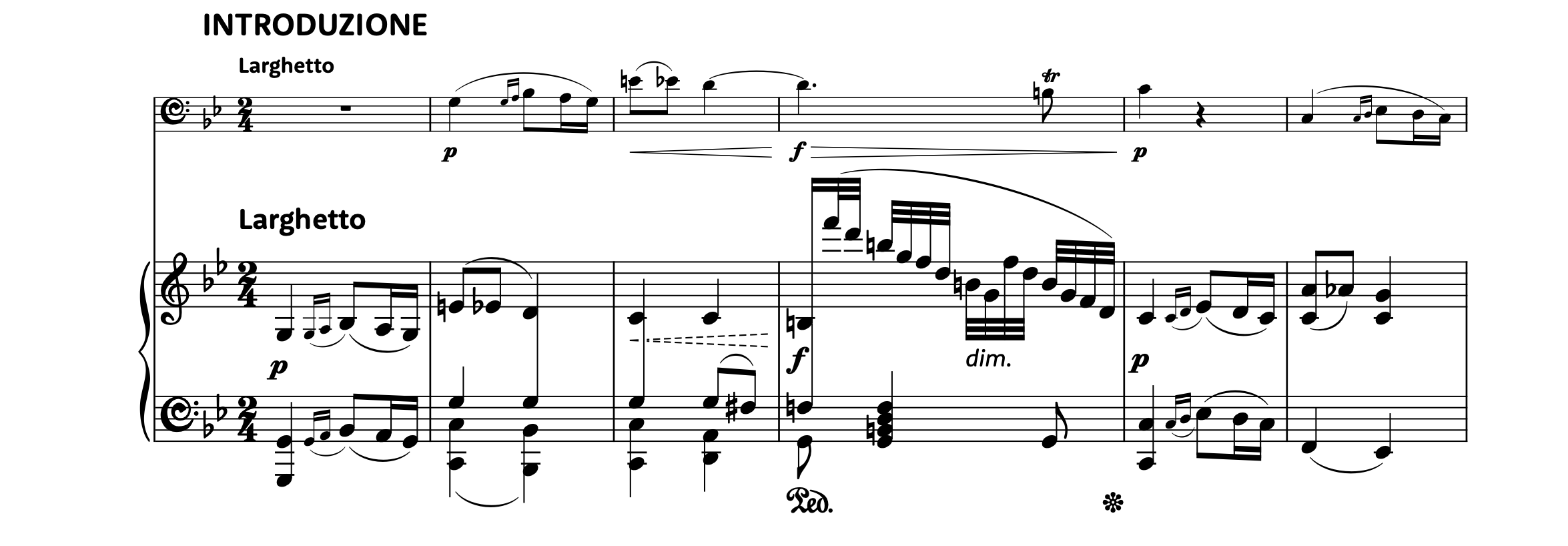
The version for piano and cello appeared in Vienna with the publisher Diabelli & Co, bearing plate number ‘D. et C. N° 5491’, and not with the same publisher, C. F. Meser, which had published the ‘first part’; the Hofmeister listing, moreover, makes no mention of a ‘2e Partie’. These elements alone do not show whether the two pieces are linked as parts of a single work. Only when both sources could be consulted side by side did the relationship between the two pieces become clearer: striking similarities emerged, as both have an introduction, after which they present the same theme with comparable harmonisations, followed by six variations, the fifth of which is an Adagio in both cases. The similarities end here, though, because the piano solo version has a 20-bar introduction, while the version for piano and cello exhibits a 108-bar one (see Fig. 1 for the opening of the latter). The six variations of the two versions, by contrast, are entirely different from each other, illustrating the range of possibilities that a single theme can offer. On the evidence currently available, the two pieces do not appear to be the first and second part of one work, but two distinct pieces, composed in the same years and sharing a composer and a theme.7 It may reasonably be assumed that the version for piano and cello was written before Mme Pesadori’s illness and subsequent death in 1834, which would make the Diabelli print a posthumous publication.
Who was Antonia Helene Pesadori?
When a work is composed in collaboration and so much is already known about one of the two composers (Dotzauer, in this case), the question arises spontaneously: who was the other one?
Antonia Helene Pechwell was a pianist, piano teacher, and composer.8 Born in Dresden on 6 March 1798 and affectionately known as ‘Antonietta’, she was the daughter of the portrait painter August Joseph Pechwell (1757–1811), Inspector of the Gemäldegalerie Alte Meister in Dresden, and of his second wife, Anna, née Stöbel. Her family was steeped in an artistic milieu: her uncle Carl von Pechwell, ennobled by Emperor Joseph II, was an engraver, and her brothers-in-law—sculptor Paweł Maliński and painter Anton Blank—were prominent figures in the Saxon and Polish cultural spheres of their time. Antonia began performing publicly at the age of eleven, playing her own compositions. While contemporary reports initially highlighted her underdeveloped left hand, they deemed the issue resolved by 1816. She studied piano with August Stephan Alexander Klengel (1783–1852) and music theory with Justus Johann Friedrich Dotzauer.9 Her playing was praised for its powerful yet sensitive qualities, so much so that her friend Francesco Morlacchi (1784–1841), an Italian composer and conductor and her future witness at her wedding, would arrange an introduction to Fryderyk Chopin (1810–1849), who attended her performances in Dresden in 1829 and a further soirée the following year.10
In 1831 Antonia Helene Pechwell married the Italian tenor Ranuzio Pesadori (1800–1871), who had been a member of the Italian Department of the Court Theatre in Dresden since August 1825. From that moment, then, she also used her husband’s name as an artist. Her last documented concert, given in Dresden on 15 March 1833, was met with great acclaim:
This artist, whose consummately beautiful playing combines rare energy and strength, captivating fire of delivery, soulful expression, and the highest brilliance of polished execution in all passages, performed Hummel’s great Concerto in B minor in a masterly fashion […]; she then played the charming Fantasy with Variations by Osborne and Bériot together with the concertmaster [Antonio] Rolla—this duo was a contest in performance between both rare artists in grace and wit.
Finally, the concert-giver played very brilliant and beautifully developed variations with full orchestra of her own composition, in which she was able to fully display her distinguished virtuosity.11
However, her life would soon be cut short: following a pregnancy that ended in a stillbirth, she would survive only for a few months, succumbing to meningitis on 20 September 1834, at the age of 36. Some of her compositions would be published in the coming years. Traces survive of the following:
- Variations brillantes sur un Theme de Himmel ‘An Alexis send’ ich Dich’, Dresden, 1828.
- Variations brillantes ‘Romance de Joconde de Nicolo’, Dresden, 1830.
- Introduction et Rondeau agréable, Leipzig, 1838.
As mentioned in the previous section, the Air Suisse varié written together with Dotzauer was published posthumously and, like all her other compositions, without opus number; the Hofmeister listing, which places her name before Dotzauer’s, suggests that her music theory teacher allowed the piece to be counted first among her works. Gratitude is due to the Sophie Drinker Institut in Bremen for its invaluable work in uncovering further information about Antonia Helene Pesadori.12 The Allgemeine musikalische Zeitung, in its issue no. 7 of vol. 37 (February 1835), would publish an obituary notice dedicated to her memory, from which a few excerpts are reproduced here:
[…] With a feeling of heartfelt admiration, may this memorial be dedicated to one taken from us all too soon—one around whose name many will surely wish to place a wreath. […]
Her rare virtuosity, her angelic purity of character, and her gracious warmth of manner, combined with a cultivated and refined mind, won her the deepest affection of all who had occasion to know her more closely.
She was in many respects an exemplary figure. Her grand, vigorous playing—at once deeply expressive and brilliantly accomplished—enchanted all who heard it and aroused universal admiration. She possessed an extraordinary facility for sight-reading, and could perceive the spirit of a work with remarkable ease. […] As a teacher, she justified the great trust placed in her by her many pupils through her thoroughness, as much as through her winning personality.
With all these rare qualities, she remained as an artist the most modest and unassuming of people—witty and engaging in society, generous of spirit, and yet at the same time a devoted and attentive wife.13
Bottom Line
Thank you for reading so far. Come back next week for the second part of this deep-dive analysis of the Air Suisse varié for piano and cello by Pesadori & Dotzauer.
You can join my mailing list to get weekly gifts and promotions; browse my editions and contact me directly for printed titles. My YouTube channel, finally, contains video renditions of most editions.
If you enjoyed this, don’t forget to like, subscribe, and leave a comment below, I read everything you write.
Musically yours,
Michele
- Published as ASE Editions 0101. The Editorial Notes are available in open access at the following links: Introduction (https://artisticscoreengraving.com/2026/09/11/dotzauer-project-episode-16/); Analysis (https://artisticscoreengraving.com/2026/09/18/dotzauer-project-episode-16-2/). ↩
- Published as ASE 0054, available here: https://payhip.com/b/kNlWV. ↩
- Published as ASE Editions 0109, available here: https://payhip.com/b/sDkMP. ↩
- Source: https://imslp.org/wiki/H._Helmuth. ↩
- Allgemeine musikalische Zeitung (AMZ), vol. 35 (1833), no. 25 (June), Intelligenz-Blatt no. IV, p. 16 (inserted between col. 420–421). ↩
- Friedrich Hofmeister: Musikalisch-literarischer Monatsbericht (1835), p. 56. ↩
- Dotzauer’s surviving correspondence of the period has not yet been fully surveyed; any exchange with Mme Pesadori could shed further light on the relationship between the two pieces. ↩
- Unless otherwise stated, the biographical information in this section follows the entry on Pechwell in the Sophie Drinker Institut’s lexicon Europäische Instrumentalistinnen des 18. und 19. Jahrhunderts (https://www.sophie-drinker-institut.de/pechwell-antonia; last accessed on 31 May 2026), which is based on contemporary press reports, diaries, and other period sources. ↩
- She is, at present, the only evidence of Dotzauer’s activity as a music theory teacher. ↩
- Friedrich Niecks, Friedrich Chopin als Mensch und als Musiker (Leipzig, 1890), vol. 1, pp. 114, 161–162. ↩
- Wiener Zeitschrift für Kunst, Literatur, Theater und Mode (1833), p. 475; translation by the editor. ↩
- See note 8. ↩
- AMZ, vol. 37 (1835), no. 7 (18 February), col. 108; translation by the editor. ↩

