
Announcing the publication of the Air Suisse varié for Piano and Cello, WoO (ca. 1833)
This article constitutes the second part of the expanded version of the Editorial Notes that can be found in the published edition, available as a printed book (on demand) as well as digitally (PayPal/Stripe — Apple Pay/Credit card).
EDITORIAL NOTES — Part 2
The Air Suisse varié for piano and cello
The source and the theme
The source used for this edition is the only known print, issued in 1835. The copy consulted came from a donor who wished to remain anonymous. A further copy is held at the Biblioteca Musicale ‘O. P. Greggiati’ in Ostiglia, Italy.1 The title page reads as follows:
AIR SUISSE | varié | pour le | PIANOFORTE et VIOLONCELLE | par | Madame Pesadori née Pechwell | ET | J. J. F. Dotzauer | Propriété des Editeurs | Enregistré dans l’Archive de l’Union | (left, plate number) N° 5491 (right, price) Pr. fl 1. 45 xCM. | VIENNE | chez Ant. Diabelli & Comp. | Graben N° 1133.
This identifies the publisher as Anton Diabelli (1781–1858), who had run a Viennese publishing house with Pietro Cappi from 1818 (Cappi & Diabelli) and, from 1824, continued it under his own name as Diabelli & Co.2 Diabelli is best remembered today for the Vaterländischer Künstlerverein (1819–1824), the collaborative project of variations on one of his own waltzes that gave rise to Beethoven’s Diabelli Variations, Op. 120.
The story of the theme is a peculiar one, and unearthing its details was nothing short of a treasure hunt. A search through the available musical sources led to an exact match in a song by the German composer Johann Nepomuk von Poißl (also spelled Poissl; 1783–1865), associated with the opera Das Donauweibchen (‘The Maiden of the Danube’), Part I.
While Poißl was a prolific and successful opera composer, Das Donauweibchen does not belong to his catalogue. It is, instead, an opera of 1798 by the Austrian composer and pianist Ferdinand August Kauer (1751–1831). Browsing the entire manuscript of the opera,3 though, revealed no trace of this song. Kauer’s opera would be so successful that another composer—Gottlob Benedict Bierey (1772–1840)—would write a third part in addition to the original two. At the end of the third part, the protagonist Hulda sings a melody that vaguely resembles this theme, but the connection is tenuous. The solution to the mystery, instead, came from the thesis ‘The Operas of J. N. von Poissl (1783–1865): Aesthetics and Ideology’ by Martin John Pickard published in May 2012:4
We know that Poissl willingly provided picturesque musical colour in other contexts. We see this for instance in the Alma-Lied, a pseudo-Austrian yodelling song he inserted into Kauer’s Das Donauweibchen in 1826, […].5
The theme is thus traced to the ‘Alma-Lied’, inserted by Poißl in Kauer’s opera in 1826. The thesis then provides the incipit of the song taken from the anthology Deutscher Liederschatz, vol. 2 (Leipzig: C. F. Peters, c. 1872, p. 12), edited by Ludwig Erk (1807–1883). Browsing through this book finally shed some light on this piece called ‘Alma-Lied’ (also ‘Alpenlied’ in other sources), whose text begins as follows:
Auf der Alma da finden die Küh’ das beste Gras
This translates as:
It is on the Alma6 that the cows find the best grass
One does not get more bucolic than that, and this is the musical incipit as found in Erk’s collection:
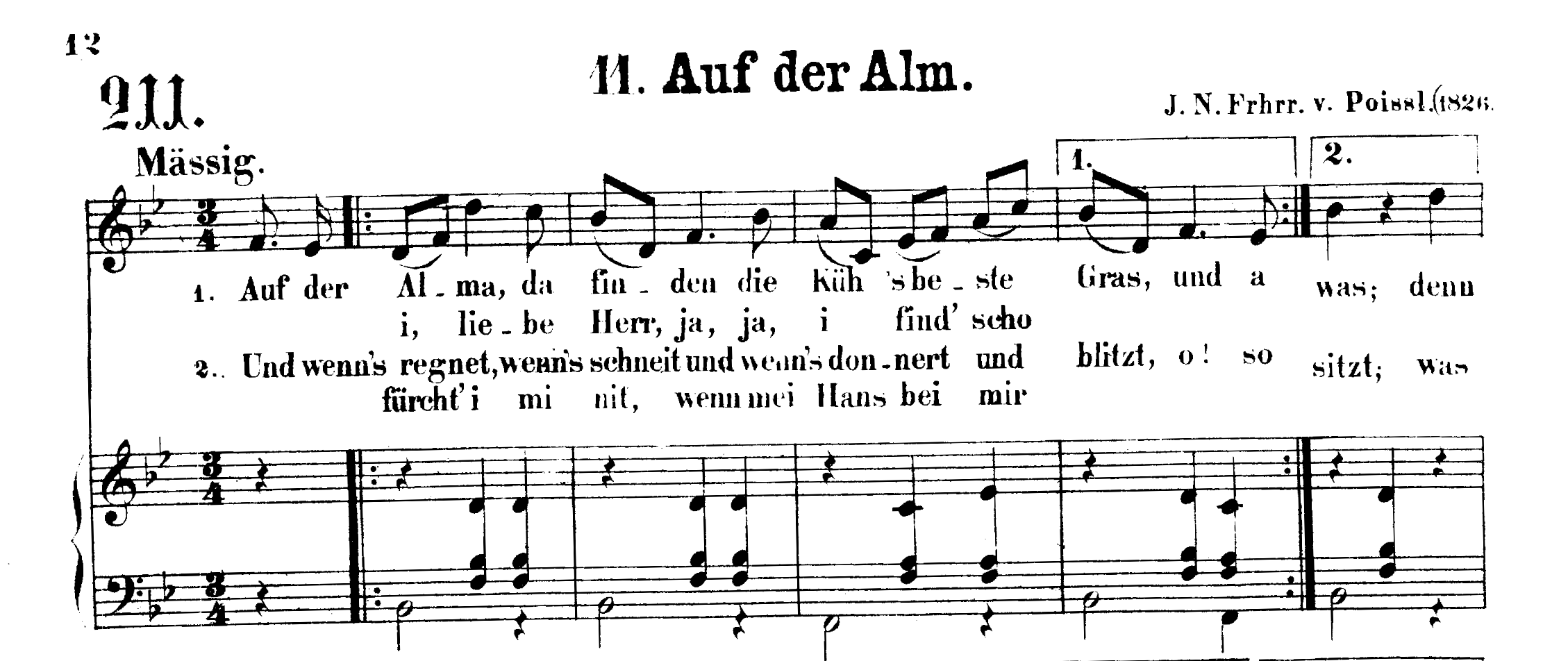
Ever since its composition, this melody has been used in numerous arrangements: for flute and orchestra (Theobald Böhm, Op. 13), for piano solo (Dotzauer, Op. 127; see above), for voice and guitar by Poißl himself, and also for two cellos (Friedrich August Kummer, Op. 22). The original song is in four short parts, the first two repeated, and the third slightly varied the second time, giving an AABBAA′D form. The theme used by Pesadori and Dotzauer, by contrast, presents the A part twice in full and slightly develops part B to give it a proper conclusion (see Fig. 3). The original, in fact, ends with a yodel-like melody which would have proven distracting for the form and for the following variations.

Analysis of the piece
The Air Suisse varié for piano and cello by Pesadori and Dotzauer is structured in two main parts: a long and elaborate introduction and a theme with six variations. The Introduzione is a Larghetto in 2/4 time, in G minor, and is 108 bars long. The Tema is an Allegretto in 3/4 time with a quarter-note upbeat, in G major, and 24 bars long. The first four variations maintain the same formal structure, size, and prevailing key. The fifth variation is an Adagio espressivo, still in 3/4 but starting on the downbeat, the prevailing key now being E minor. It is also slightly longer than the previous variations, at 31 bars. The sixth and final variation follows the same scheme as the first four variations for the initial 24 bars, before erupting in an extended Coda (bb 25–116). The piece in its entirety is 375 bars long.
The introduction revolves around two main thematic ideas, the initial one more melodic, the second one more rhythmically inclined. From the very outset, imitation reigns supreme, with the piano proposing the first idea with both hands in unison and the cello immediately replying one bar later (see Fig. 1).
The melodic contour of a sixth should be kept in mind for what follows. A descending arpeggio in the piano’s right hand moulds the tonic harmony into a dominant one, favouring the repetition of the first idea in C minor. The second period (bb 9–20) serves as a modulatory bridge towards the second idea, finally landing in Eb major. These first few bars already show how prominent the piano part is, the cello often being relegated to an observant and reflective role.
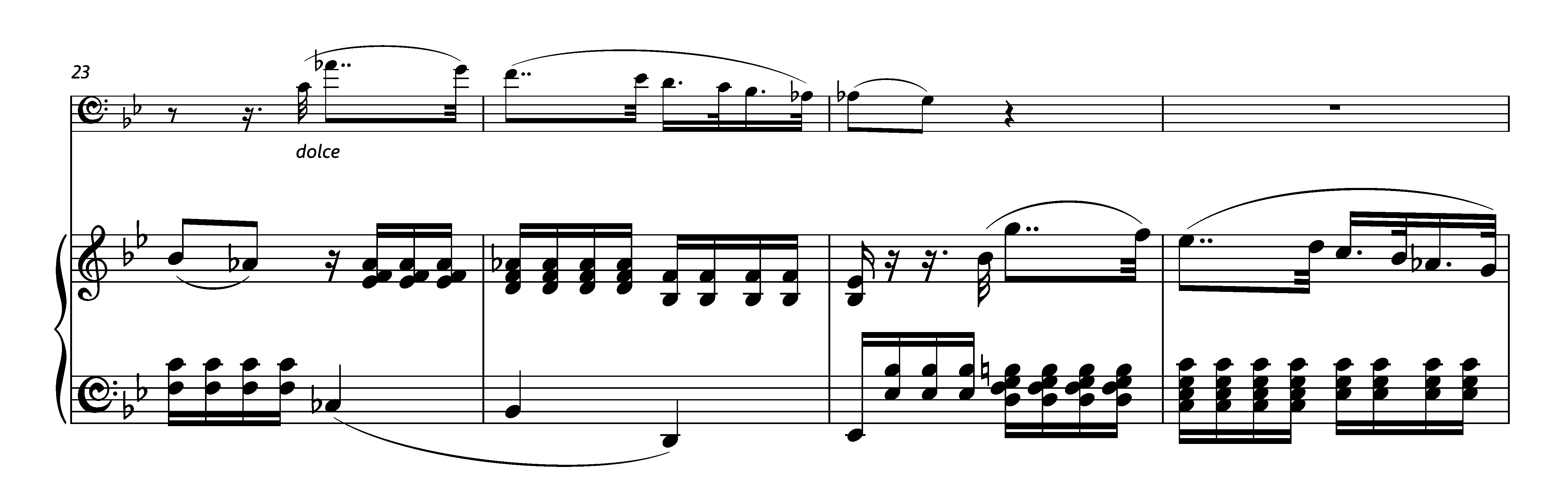
The new idea, presented by the piano alone, jumps up a major sixth before descending stepwise to a melodic appoggiatura. The cello then reacts with the same contour (see Fig. 4) but starting a major second above and using a minor sixth jump instead of a major one, both intervals being already present in the opening melody. The piano then proposes the same melody but changes the final appoggiatura, inviting a broader response in the cello with an octave leap that paves the way to a short transition in Ab major/minor. This uncertainty allows for a sudden shift to an augmented fifth above (E major, bb 33–40), where the second idea shines with extreme brightness in the left hand first and in the right hand four bars later. Triplets make their first appearance here in the accompaniment, while the cello tries to project some variation into the melody following the initial melodic leap.
With a deceptive cadence, the first idea comes back, this time in C major, with the piano stealing all the attention: the melody winds through both hands while sextuplets of thirty-second notes rumble above and below. A glimpse of the second idea with its double-dotted rhythm tries to peep from behind the clouds (b 44), but the entrance of the cello prevents it from getting any further. A sudden Eb in the left hand of the piano announces the modulation to Bb major, the key in which the first idea will dominate for the next period (bb 51–60). Accompanied by sixteenth-note triplets, the second idea now returns in C major with a slightly syncopated variation in the piano’s right hand. Neither idea wants to allow the other one to prevail, though, and so it is the first idea’s turn once again (b 69), the melody running in imitation between the two instruments while fast broken chords in thirty-second notes provide harmonic support. For a moment, it appears that the first idea has managed to come out ahead, with a modulatory period propelling the discourse through Bb major, A minor, C major, and B minor. Finally (b 85), the imitation becomes tighter (now at a distance of half a bar) and so do the key changes: E minor, G major, Eb major, and, eventually, D major.
The return of the second idea in the peaceful and positive key of D major (bb 89–96) sounds like the breaking of dawn after too long a night. The first idea then resurfaces one last time in G minor, with the piano carrying the entire line while the cello accompanies with arpeggios in sixteenth-note triplets. The introduction ends on a half cadence, the cello hinting at the change in mode with a B natural in the grace notes preceding the last bar.
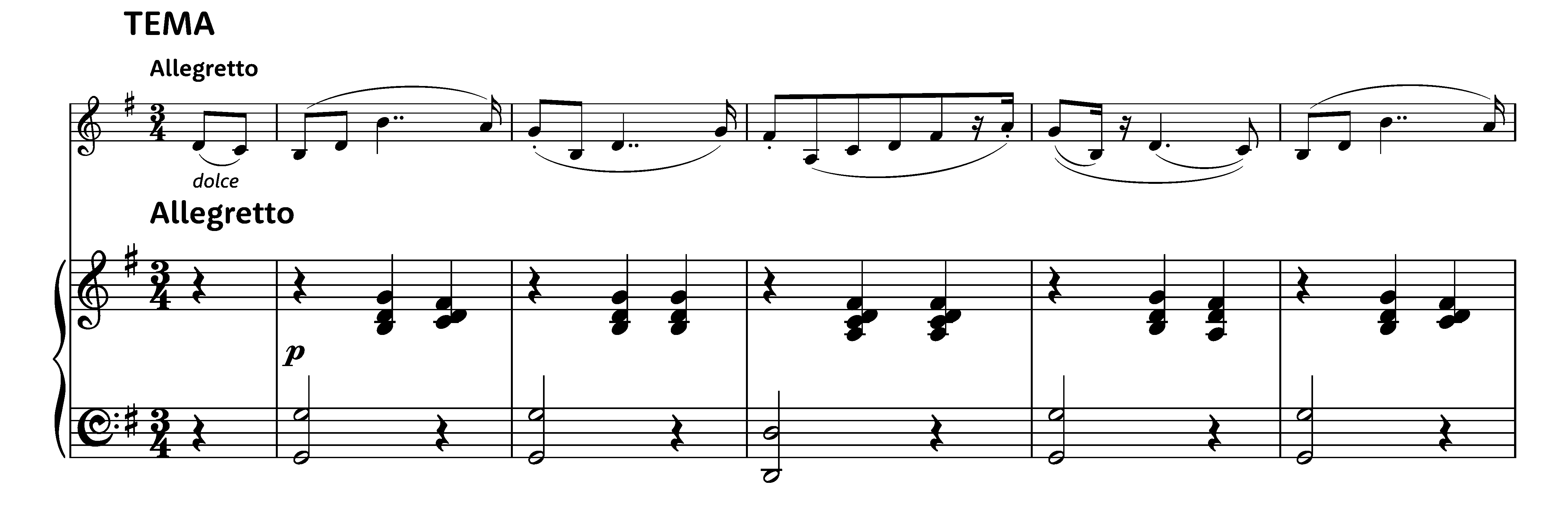
The appearance of the bucolic Swiss theme, in G major, after about three minutes of introduction, provides an astonishing contrast (see Fig. 5). The simplicity of the harmony is also staggering when compared with what came before—essentially a continuous alternation of tonic and dominant functions. The theme spans 24 bars over three simple and regular periods, the first and third ones showing few differences between each other, and the second being set in the dominant key of D major. This time it is the cello that sings without interruption, the piano discreetly accompanying with a bass note on the downbeat and two chords in the rest of the bar. The upward and downward jumps of a sixth dominate the melody’s first and third periods, the second one being less broad in its melodic shape. Compared with Poißl’s original theme, the dotted rhythm on the upbeat is dropped in favour of a double-dotted quarter note in the second and third bars: a poetic licence, one might say.
Variation 1 is strongly dominated by the piano, the first period revolving around an upward jump of a major sixth followed by a descending chromatic line. The second period, by contrast, focuses on ascending chromatic scales and arpeggios. In this variation, the cello is little more than a polite observer, providing melodic support and depth of sound to the otherwise independent piano line.
Variation 2 inverts the balance established by the previous variation by giving the cello full control of the scene with ascending chromatic thirds in double stops. The second period, however, proposes a dominant pedal on the A string accompanied by a melodic line on the D string, the latter assisted by the piano’s right hand a third below. After two such bars, two-octave ascending arpeggios take the lead. The first period then returns unaltered.
Variation 3 is marked Un poco più lento, probably to allow the fiendishly difficult piano part to remain playable. This is much harder to play on today’s pianos because of the increased travel of the keys and of their slightly increased width. The first period begins with an ascending scale in the left hand, followed by descending arpeggios in the mid-to-low register. Both hands then engage in parallel scales, the two hands a tenth apart. Ascending arpeggios then introduce new ascending scales in parallel tenths, before descending arpeggios bring the first period to a close. The second period tries to be more melodic, the initial arpeggio in the left hand introducing the ornamented melody in the right hand. Whenever one hand is not playing the main part, then, the other accompanies with broken chords. The first period then returns unchanged. Once again, the cello simply accompanies throughout the variation, this time in pizzicato.
Variation 4 restores parity, with the cello attaching the triplet motif to the theme, and the piano accompanying with unassuming chords. When the triplet pattern risks becoming predictable, the cello draws scalar and arpeggiated lines ornamented with either mordents or passing notes. The first period closes with an upward sixth jump, followed by a descending scale and an ascending arpeggio. In the second period, the first phrase sees the piano using an ascending scale fragment in the left hand and broken chords in the right hand, while the cello almost improvises on the proposed harmony. The second phrase is a long, descending ornamented scale in sixteenth-note triplets, contrasted with the contrary-motion scale in thirds in the piano. The third period repeats the first, unchanged.
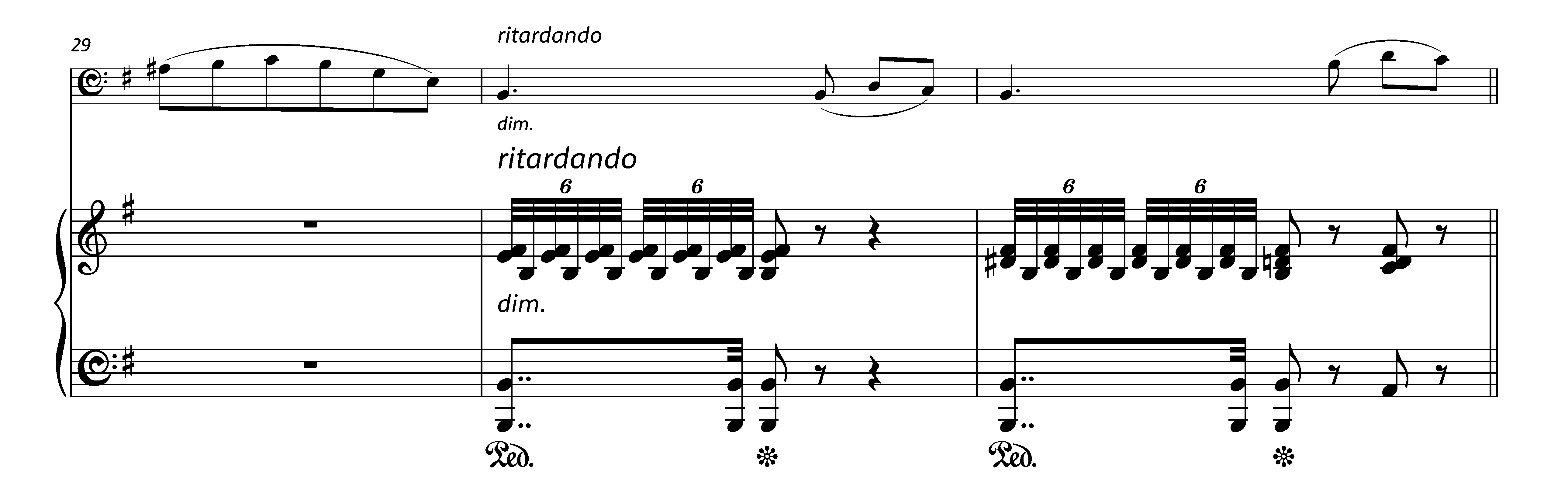
As mentioned before, Variation 5 is the only one starting on the downbeat. Furthermore, it changes the key to E minor and slows everything down to an Adagio espressivo. The first phrase is all for the piano, a beautiful minor-mode variation of the original theme, the cello entering only in the last bar (b 4) with an ascending arpeggio followed by a long trill. In the second phrase, the theme passes to the left hand, the right hand accompanying in scales and arpeggios while the cello reaches a high E5,7 beyond the end of the fingerboard of the time. It should be remembered that the cello’s fingerboard was shorter by a major third compared to today, reaching only D5. The second period gives the cello a chance to shine with the theme proposed in C major, albeit for just four bars. The piano takes back the scene with fast descending arpeggios and ornamented descending scales. The third period (bb 17–23) is incomplete, its supposed last bar being already the beginning of the fourth and final period of this variation. It would otherwise be identical to the first period were it not for the fourth note of the right hand of b 21 in the piano (a G4 instead of a B4). The fourth period lingers around the Dominant of E minor, the bass moving from A# to B to C and back, building diminished sevenths at one point and French augmented sixth chords at another. The last two bars have to bring the piece back to G major, and this is achieved by one bar of dominant harmony omitting the leading tone; half a bar adding the leading tone; and, finally, a sudden third degree of G major (B minor) followed by its dominant seventh (see Fig. 6).
The sixth and last variation is, together with the introduction, the most interesting section of the piece. While the first three periods replicate the same structure as Variations 1–4, the Coda that follows elaborates all the material used so far in a most creative way. The first period opens with the theme stated by the cello in a delicately ornamented form, the piano gently accompanying with chords alternated between the two hands. The second period (bb 9–16) gives the ‘answer’ melody to the piano, which elaborates on it in the second pair of bars of each phrase, first in triplets, then in quadruplets, the cello reacting to the main melody with a one-bar delay. The cello line of the third period is unaltered, while the accompaniment is entirely different: the right hand doubles the cello one octave above, while the left hand fills in with arpeggios in sixteenth notes. The fourth period marks the beginning of a long Coda (bb 25–116) with a joyful two-bar melody marked dolce in the cello. The piano, while accompanying with the left hand, reacts in imitation just one bar later, creating an amusing juxtaposition. The first imitation is exact, while the second is in contrary motion, the four-bar phrase then being repeated unchanged. After four imitations in total, the cello no longer proposes a new line, switching to a reactive role and answering the piano’s descending and ascending arpeggios, which alternate triplets and regular sixteenth notes, with arpeggios in contrary motion. The fifth period (bb 37–44) is a reminiscence of Variation 4 where a descending ornamented scale in triplets in the piano’s right hand is answered by an ascending one, the neighbouring tone being on the opposite side of the scale’s direction. The next period (bb 45–52) has the cello move into the stratosphere and then gradually descend with upward arpeggios, each starting on a lower note than the previous one. The piano is in full swing once again, the right hand exhibiting descending broken chords in sixteenth-note triplets, while the left hand ascends in straight sixteenth-note ones. The last two bars mark a shift to something different, with a change of direction in the right hand and a doubling of rhythmic density in the left.
The next few periods repeat previously used material, the seventh repeating the fourth—beginning of the Coda—, and the eighth the fifth, although the cello replaces the ornamented, mordent-like ascending scales with broken sixths first and broken octaves then. The ninth period that follows is an exact repetition of the sixth one, thus increasing the overall tension towards the final section. Descending arpeggios in the cello are answered by ascending broken octaves in the piano (bb 82–85, 90–93), while ascending arpeggios are answered by descending ones (bb 86–89, 94–97). The harmonic progression then becomes tighter in the twelfth and penultimate period, the piano proceeding in broken chords where each resolution becomes the Dominant of the following chord. The left-hand accompaniment is eventually given to the cello, while the piano repeats the progression one octave above. The final period of the variation—and of the piece—is once again tremendously demanding for the piano because of the large jumps coupled with a potentially breakneck speed. The first phrase alternates tonic and dominant chords while the last bars stay firmly on the Tonic, the cello tightening the syncopation before the final chords while the piano manages to close the whole piece with the same dotted rhythm that had been so prominent in the introduction.
About this edition
Based on the only known print of the piece (Vienna, Diabelli & Co., 1835), this edition incorporates all the corrections necessary to bring its notation in line with modern standards. Any correction that deviates significantly from the source is documented in the Critical Notes at the end of the volume. The cello part is offered in two versions: one with the original markings by Dotzauer, and one with Friedrich Thiele’s performance suggestions. The piano part has been checked, corrected, and edited by Andreas Hecker, who, with Friedrich Thiele, gave the modern premiere of this piece at the Dresdner Musikfestspiele 2026 (‘Dotzauer Abend’, 13 June 2026).
Acknowledgements
My deepest thanks go to the City of Dresden and the Dresdner Musikfestspiele for supporting the creation of this edition and for deciding to dedicate an entire evening of their programme to the music of Dotzauer. It has been a true honour to have had the privilege of witnessing the first Dotzauer Evening in modern history, and to offer my contribution to bringing the Dresden cello hero back to the stage from which he should never have been excluded. I am immensely grateful to Jan Vogler, Artistic Director of the Dresdner Musikfestspiele, who, from our very first meeting, believed in this project around Dotzauer and heroically strove to make it a reality.
A heartfelt thank-you goes to the musicians who agreed to take on these technically challenging pages, both for their flawless, spectacular performance and for their editorial support for this edition. They are Friedrich Thiele, principal cellist of the Sächsische Staatskapelle Dresden, and Andreas Hecker, pianist and professor at the Hochschule für Musik Carl Maria von Weber Dresden.
The Editor,
Michele Galvagno
Saluzzo, Italy — 12 October 2026
Bottom Line
Thank you for reading so far. I hope you liked this deep-dive analysis of Pesadori & Dotzauer’s Air Suisse varié for piano and cello.
You can join my mailing list to get weekly gifts and promotions; browse my editions and contact me directly for printed titles. My YouTube channel, finally, contains video renditions of most editions.
If you enjoyed this, don’t forget to like, subscribe, and leave a comment below, I read everything you write.
Musically yours,
Michele
- Shelf-marks: Edizioni Musiche A 66 a / 3 (score) and A 66 b / 3 (cello part). ↩
- On the history of the firm, see Alexander Weinmann, Verlagsverzeichnis Peter Cappi und Cappi & Diabelli (1816 bis 1824) (Beiträge zur Geschichte des Alt-Wiener Musikverlages, Reihe 2, Folge 23; Vienna: L. Krenn, 1983), and Verlagsverzeichnis Anton Diabelli & Co. (1824 bis 1840) (Reihe 2, Folge 24; Vienna: L. Krenn, 1985). ↩
- Available in open access at: https://imslp.org/wiki/Das_Donauweibchen_(Kauer,_Ferdinand). Last accessed on 28 May 2026. ↩
- Available in open access at: https://etheses.whiterose.ac.uk/id/eprint/3353/. Last accessed on 28 May 2026. ↩
- Martin John Pickard, ‘The Operas of J. N. von Poissl (1783–1865): Aesthetics and Ideology’ (PhD thesis, University of Leeds, 2012), p. 60.
Although the thesis mentions that the insertion should be found in the opera’s manuscript, kept at the Bayerische Staatsbibliothek (shelf-mark St. th. 166-2), it was not possible to access the relevant resource. The link to the manuscript given in the opera database of the University of Mainz (https://www.operndb.uni-mainz.de/details/manuskript?id=20) leads back to the same page. ↩ - Here, ‘Alma’ stands for Alm, the Alpine mountain pasture where cattle graze in summer. ↩
- Middle C is designated as C3, following the European convention. ↩

