
An Artistic Score Engraving update from July 2026
Dear all,
Welcome back to a new instalment of the ASE newsletter, hot from 36 °C NW Italy where I am, literally, cooking at my desk. They say slowly-, low-temperature-cooked meat is the best, and I certainly agree with it, but I didn’t think I would have ever been the protagonist of that story. On paper, 36 °C is not an impossible temperature to cope with, but when it’s hopelessly humid and there is no air circulation, it starts to get rough. Anyway, I hope you are doing well wherever you are, and that you are managing to stay safe and cool (with or without AC).
June was an incredibly packed month, both with last-minute engraving deliveries and students’ concerts. The true highlight, though, was something that I had purposefully kept relatively hidden to avoid getting my hopes too high. Between the 11th and the 14th of June, my wife and I flew to Dresden, Germany, where, among other things, we attended the first Dotzauer Abend (Dotzauer Evening) of modern history. So sit back, grab a fresh drink, relax, and enjoy the recount of this long, exciting weekend.
Arrival and first impressions
Leaving a 35 °C Italy for a 23 °C Germany was an excellent start, even if the grey of Frankfurt airport (no direct flight from Italy to Dresden) was a bit heavy. We didn’t expect Saxony to be so windy and with such capricious weather: scorching sun would leave way to menacing grey clouds seasoned with 30-km/h winds, followed by quick rain showers. The whole cycle would repeat pseudo-randomly for the whole day, every day! Locals seemed perfectly at ease with this, some bearing small umbrellas and others just unfolding their handy cloaks when necessary. At half-a-million people, Dresden has no direct comparison with any Italian city (Genova being the closest one) and we greatly appreciated the exceptional public transports—well, anything compared to Italy has an easy time with that—and the general calm. If we were in Torino with that few people around in late night hours, we would have not felt safe at all, especially near the main train station where our hotel was. Instead, Dresden felt like a completely safe place to wander at any time.
Walking by the Elbe river and seeing with our eyes what Canaletto paintings exhibited in the museums in Torino showed was a refreshing feeling. Moreover, seeing how the Frauenkirche was rebuilt exactly as it was from those paintings after the “Allied forces” razed the city to the ground during WW2 (shame on them, no discussion allowed here) was deeply moving. This especially because it was the population who raised the money needed to finance the rebuilding. More on the different approach to culture and art between Italy and Germany a bit later.
Touching history
On Day 2 we got up early to reach the Sächsische Landesbibliothek — Staats- und Universitätsbibliothek Dresden (SLUB) where a wealth of Dotzauer material had been reserved for us to take pictures of. It was a bit difficult to get to the correct place because—to my surprise—not so many people were fluent in English. Nevertheless, they were all beyond kind and helpful and our exploration could soon continue. The building was massive, with multiple floors, corridors, rooms, lifts, private boxes for studying, and a magical silence throughout the place. Honestly, I could live in there! Once we reached the Special Reading Room, we were greeted by the chief librarian, who was waiting just for us and had a big trolley with all the scores we had ordered ready for us.
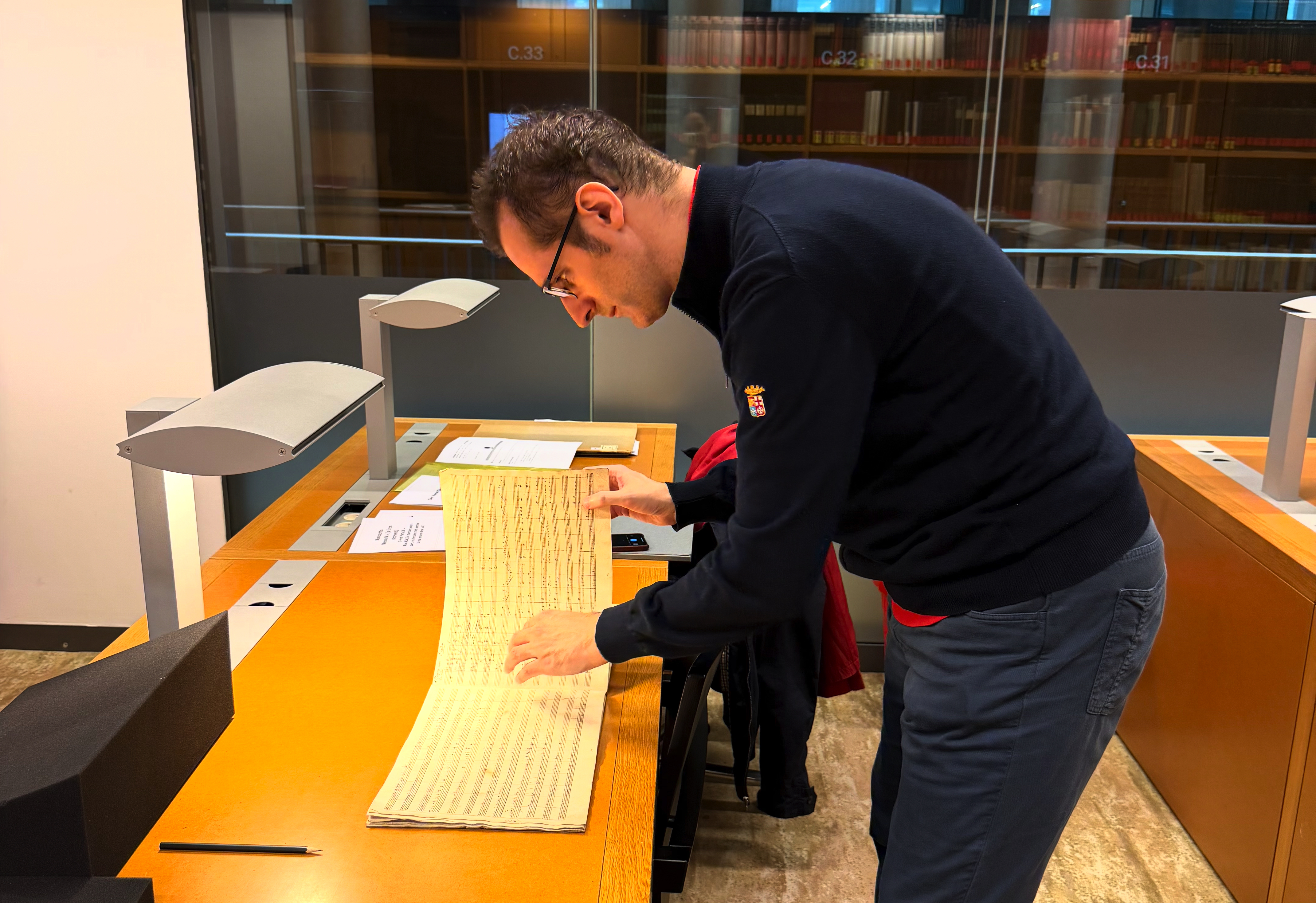
The emotion of being able to touch Dotzauer’s manuscripts was beyond description, and both my wife and I were stunned by the quality of his handwriting: clear, careful, almost architectural. It will be a great challenge to recreate the same feeling with modern means. Here is something I would like to show you: Dotzauer’s signature:

We also had the chance to chat with another librarian, who showed us how to best use the search engine when something was apparently not showing up. She also explained to us how, in the past decade, they had been collaborating with Russian libraries to try to reconnect the titles that Soviets had taken away after WW2. Apparently, they had replaced their ID with Russian-system ones, making all of them potentially lost or too difficult to find.
Unfortunately, no trace of his Symphony or his Opera could be found, not even in the war-loss catalogue, so the research for those items will have to continue.
A miracle beyond belief
On Day 3 (June 13), we reached the Palais im Großen Garten, which, as the name implies, is a beautiful Baroque palace in the heart of Dresden. There, we had the privilege of listening to the rehearsal of the upcoming concert, which would feature six of our editions that are quickly reaching publishing level and that will be released over the summer.
Then, at 7 PM—the best time for an evening concert, more on this later—I joined the Artistic Director of the Dresdner Musikfestspiele, Jan Vogler, on stage for a brief introduction on Dotzauer, the pieces we were about to listen to, and the process of making a modern edition. Besides the emotion of being next to one of my cello heroes, I was blown away by the fact that, on a Saturday evening, the 400-seat hall was packed full of people who had deliberately chosen to purchase a ticket for a concert dedicated to a second-rate composer and where no “famous” music was featured. You may say that it was Dresden, Dotzauer’s city, but truly, few knew or remembered about that, or considered that Dotzauer had been principal cello of their orchestra for over thirty years. One of the organisers had encouraged some of her cellist friends to come to listen, and reported how they had all replied in chorus:
Oh, no! Dotzauer! I hate his studies!
When she told them that the evening was about his chamber pieces, though, they changed their mind—something that I am quite confident would have never happened in my country.
Mr. Vogler was just wonderful in both introducing the evening and in translating my speech in German for the audience. In less than 10 minutes, we gave them all the details they needed to feel ready for what was about to come. Thereafter, I joined my wife in the audience and the concert could begin.
There were four pieces for cello and piano based on opera motifs and popular themes, a piece for two cellos and piano based on a popular Tyrolese tune, and his only composition for three cellos, the Six Pieces, Op. 104. The protagonists were the three principal cellists of the Sächsische Staatskapelle Dresden, Friedrich Thiele, Sebastian Fritsch, and Norbert Anger, supported by the amazing Andreas Hecker of the Dresdner Hochschüle fur Musik at the piano.
The concert, planned to last about 1h 15m, ended up taking about 30m more with our introduction and the thundering applauses that made the artists come back on stage twice after each piece—plus an encore. This truly let me openmouthed in pure awe because, seriously, the audience loved both their playing and the pieces themselves, showing how people are more than ready for cellists playing this kind of virtuoso repertoire that violinists play at every single concert. The bias that cellists should refrain from these pieces to play only the ‘big repertoire’ (please define that in a way that doesn’t sound like a twisting) was finally proven wrong. There were kids, even 3-year-young ones, who listened in total discipline until the end of the concert. Some among them had a little snack to keep concentration up between pieces, some had a teddy bear to feel comfortable, but the important thing is: they all stayed there because their education, their environment, their culture, they all taught them that this is good, that this is normal. And this is honestly what (positively) shocked us the most. We knew the concert would’ve been great; we knew the players would’ve been fantastic; we did not expect this kind of success and appreciation from the audience.
To those who would like to say:
But this is Germany, it is another league!
I would urge them to consider two things: if they got to that level of education (because that’s the point!), it means that someone decided to invest in this because they believe that music and art are critical for their people. Furthermore, if this was just “a usual German reaction to a masterful performance”, the musicians would’ve not written to me in the days following the concert to say how many people contacted them privately to tell them how lovely these pieces were.
Aftermath
After the concert and all the greetings, we came back to the city centre to discharge the abnormal amount of adrenaline lingering within us. We even found a pizza-place which looked promising and, of course, it was owned by an Italian and had two Italian pizza makers! On Sunday, then, we enjoyed a bit of the city—the wonderful museums in and around the Zwinger Palace; took a picture with a Wagner plaque (he was in Dresden in 1842, conducting the premieres of Rienzi and The Flying Dutchman, to which Dotzauer was principal cello; tried a local bakery; enjoyed functional public transports a bit more! It was then time to leave for the airport and to eventually get back home.
Culture is a choice!
A closing thought about the impressions we got from the way culture and art are handled in Germany. Differently from basically anywhere else in the world, culture, art, and music in Germany are central to everyday life. Where we see billboards with a certain soda, a certain burger, and a certain fashion brand, in Germany you see the advertisement for an opera, a theatre, and a symphonic concert. This means that, in there, art is a business—with all its downsides included, of course, but I’d still prefer that—and you see the effect reflected in the concert audiences. Discipline, enthusiasm, tremendously low average age, young children listening to two-hours of classical music without a single disturbing noise. There is a catch here, though: concerts in Germany start, at the latest, at 7.30 pm. In Italy, concerts start at their earliest at 8 pm (and only in big cities) but usually at 9-9.30 pm. Talking about this wonderful experience in Dresden with the parents of my students, they confirmed that, for them, going to the nearest big city (Torino) with small kids who around 9 pm start heading towards bed, coming back at 1 am at the earliest, and having to go to school the day after would just be impossible.
So, two main issues emerge here:
- Smaller towns have zero to not enough cultural events
- Existing classical music events start too late in the evening to be truly accessible
About point 1, the choice is merely political: invest in that instead of in stupid, anti-hygienic door-to-door recycling policies or in other questionable brainwashing activities. Right, an acculturated population may prove harder to control and submit, I get it.
About point 2—sighing heavily—one slams his face against two sacred institutions in Italy: the aperitivo and the family dinner. These things, especially the second one, are beyond untouchable, and it will take 20–30 years if we start now to nurture a positive change in that regard.
Talking with colleagues, customers, and friends about this, the adage had been:
Oh, but that’s Germany. They are a happy lonely island in the world, perhaps with a bit of Austria strolling by…
Well, in my opinion, everything is a choice: if someone did this, then it is possible to—if not match it—improve by being inspired by it. Then positive changes nurture positive changes. It is a virtuous circle, but it needs to start somewhere. Novak Djokovic, the GOAT tennis player from Serbia, when interviewed a few months ago about what he remembered most fondly about his first years as a young trainee, said that his trainer, a lady, picked him up every day from school, brought him to her home, and had him listen to classical music. Every, single, day! No wonder that he became one of the humblest sportsmen of all time, the most respectful of adversaries, and the most disciplined with his body and technique.
ART, CREATIVITY, CLASSICAL MUSIC, my friends, are the keys to everything else. If we focus our educational systems on that, we may have a chance. If we do not, then we are already doomed, and may very well file for being the next one to abandon ship.
But why ‘Dotzy’?
Effectively, I had not explained the origin of the title of this post. Many years ago, when my cello class was quite big, there was a gifted student who loved Dotzauer’s solo études. One day she stopped playing, looked at me, and said:
You know, master, we should get a class dog and call him Dotzy!
Then she resumed playing…
Bottom Line
Thank you for reading this up to the end. I hope you enjoyed this recount of what was the coronation of a dream that started almost three years ago. Please, share with me what you think, especially about how concerts, music education, and art are managed where you live. I read everything and try my best to reply as swiftly as I can.
You can join my mailing list to get weekly gifts and promotions; browse my editions and contact me directly for printed titles. My YouTube channel, finally, contains video renditions of most editions.
See you next month for the next ASE update. Please let me know what you are doing and where your musical adventures are bringing you.
Yours,
Michele

